
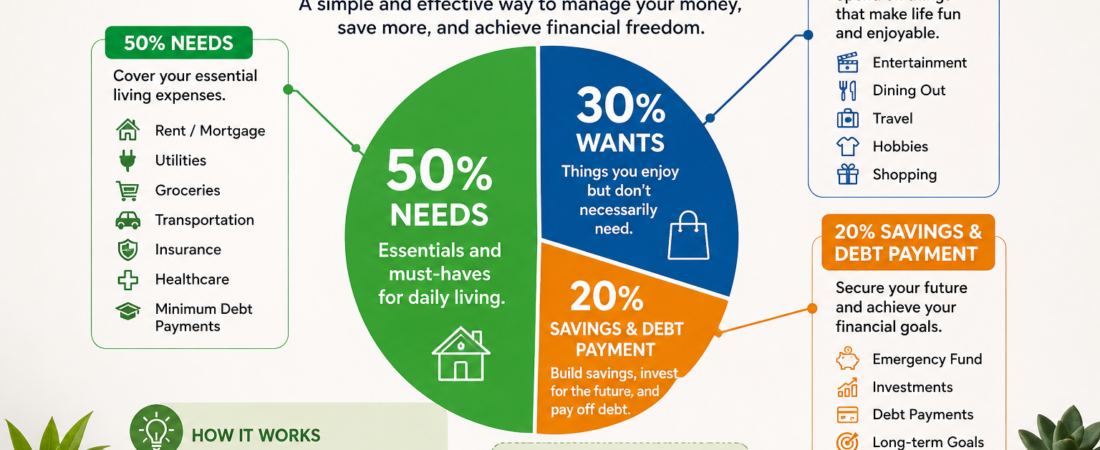
Managing money can be challenging, especially when you are not sure how much you should spend, save, or use toward financial goals. The 50/30/20 budget rule is a simple budgeting method designed to help you divide your income into three broad categories: needs, wants, and savings or debt repayment.
The rule is easy to understand and can provide a useful starting point for people who are new to budgeting. However, it is not a strict formula that works perfectly for everyone. Housing costs, income, family responsibilities, debt, and other circumstances can affect how much you are able to allocate to each category.
Here is how the 50/30/20 rule works and how you can use it in your own budget.
What Is the 50/30/20 Budget Rule?
The 50/30/20 rule divides your after-tax income into three categories:
- 50% for needs
- 30% for wants
- 20% for savings and debt repayment
For example, if your monthly take-home income is $3,000, the basic guideline would look like this:
- $1,500 for needs
- $900 for wants
- $600 for savings and debt repayment
These percentages are guidelines rather than requirements. Your personal financial situation may require you to adjust them.
50% for Needs
The first part of the rule focuses on essential expenses. These are costs you generally need to pay to maintain your basic lifestyle and meet important financial obligations.
Common needs include:
- Rent or mortgage payments
- Groceries
- Utilities
- Transportation
- Basic insurance
- Healthcare expenses
- Minimum debt payments
- Essential household expenses
The exact definition of a need can vary from person to person.
For example, transportation may be essential if you need a vehicle to get to work, while someone who works remotely may have much lower transportation costs.
If your needs already take up more than 50% of your income, do not assume that you have failed at budgeting. Housing and other essential costs can vary significantly depending on where you live and your circumstances.
Instead, use the rule as a starting point for understanding your spending.
30% for Wants
The second category is for things you enjoy but could potentially live without.
Examples include:
- Restaurant meals
- Entertainment
- Streaming services
- Hobbies
- Vacations
- Shopping
- Non-essential subscriptions
- New electronics
- Personal treats
Wants are not necessarily bad spending. Enjoying your money is part of a healthy financial plan.
The purpose of this category is to create a limit so discretionary spending does not consume money needed for essential expenses, savings, or important financial goals.
If you regularly spend more than 30% on wants, review your expenses and decide whether you want to reduce some of them.
20% for Savings and Debt Repayment
The final 20% is intended for improving your financial position.
This can include:
- Emergency savings
- Retirement savings
- Other long-term investments
- Savings for major goals
- Extra debt payments
For someone with high-interest debt, paying down that debt may be a major priority. For someone with little debt and sufficient emergency savings, more money might be directed toward long-term investing or other financial goals.
The important idea is to make consistent progress rather than allowing all of your income to disappear into everyday spending.
Example of the 50/30/20 Rule
Imagine that your monthly take-home income is $4,000.
Using the basic rule:
50% needs: $2,000
This could cover housing, groceries, utilities, transportation, insurance, and other essential expenses.
30% wants: $1,200
This could include entertainment, dining out, hobbies, shopping, and subscriptions.
20% savings and debt: $800
This could go toward an emergency fund, retirement savings, investments, or additional debt payments.
Your actual numbers will depend on your income and expenses.
What If the Rule Does Not Fit Your Situation?
One of the biggest advantages of the 50/30/20 rule is that it is easy to understand. However, its simplicity can also be a limitation.
For example, someone living in an expensive area may spend considerably more than 50% of their income on housing and other necessities.
Someone with a low income may also have little flexibility after paying essential bills.
On the other hand, a person with a high income and relatively low expenses may be able to save substantially more than 20%.
In these situations, use the rule as a framework rather than a strict requirement.
How to Adapt the Rule
If 50/30/20 does not fit your circumstances, adjust the percentages.
For example, you might temporarily allocate more toward needs and less toward wants while dealing with high essential expenses.
Alternatively, if your essential expenses are low, you may choose to save more than 20%.
The right budget should reflect your current financial reality while helping you make progress toward your goals.
How to Start Using the Rule
Start by calculating your monthly take-home income.
Next, list your expenses and divide them into needs, wants, and savings or debt repayment.
Add up each category and compare your actual spending with the 50/30/20 guideline.
You may discover that you are spending more on wants than you realized or that you are already saving more than 20%.
This exercise gives you a clear picture of your current financial habits.
Focus on Needs First
When creating your budget, make sure essential expenses are covered before increasing discretionary spending.
Housing, food, utilities, transportation, healthcare, and other important obligations should receive priority.
If essential costs are too high, look for realistic ways to reduce them. This might involve changing a service plan, reducing transportation costs, finding cheaper alternatives, or reviewing recurring expenses.
Do not cut essential needs simply to force your budget to match an arbitrary percentage.
Automate Your Savings
One simple way to make the 20% category easier to maintain is to automate savings.
You can arrange for money to move into a savings or investment account after receiving your income.
Automation reduces the need to make the decision manually every month.
If 20% is not possible right now, start with an amount you can manage consistently and increase it when your financial situation improves.
Use the Rule to Control Lifestyle Inflation
As your income increases, it can be tempting to increase spending immediately.
Lifestyle inflation occurs when spending grows as income grows. While improving your lifestyle is not necessarily a problem, increasing expenses too quickly can make it difficult to build savings.
When you receive a raise or increase in income, consider directing part of the additional money toward savings, investments, or debt repayment.
This can help you improve your financial position while still allowing you to enjoy some of the additional income.
Common Mistakes to Avoid
When using the 50/30/20 rule, avoid treating it as a rigid requirement.
Do not assume that every expense belongs in only one category without considering your circumstances. Also, avoid ignoring irregular expenses such as annual bills, repairs, gifts, and other occasional costs.
Another common mistake is focusing only on percentages instead of actual financial goals.
A budget should help you pay your bills, reduce financial stress, build savings, manage debt, and work toward the future you want.
Benefits of the 50/30/20 Rule
The method has several advantages for beginners.
It is:
- Easy to understand
- Simple to calculate
- Flexible
- Helpful for identifying spending patterns
- Useful as a starting point for budgeting
- Focused on both current spending and future goals
You do not need complicated spreadsheets or advanced financial knowledge to begin.
Conclusion
The 50/30/20 budget rule provides a simple framework for dividing after-tax income between needs, wants, and savings or debt repayment. The traditional guideline suggests allocating 50% to needs, 30% to wants, and 20% to financial goals.
However, personal finances are different for everyone. Your ideal percentages may change depending on your income, housing costs, debt, family responsibilities, and financial goals.
Use the 50/30/20 rule as a starting point, track your actual spending, and adjust the categories to fit your circumstances. The most useful budget is one that is realistic, sustainable, and helps you make steady progress toward your financial goals.