
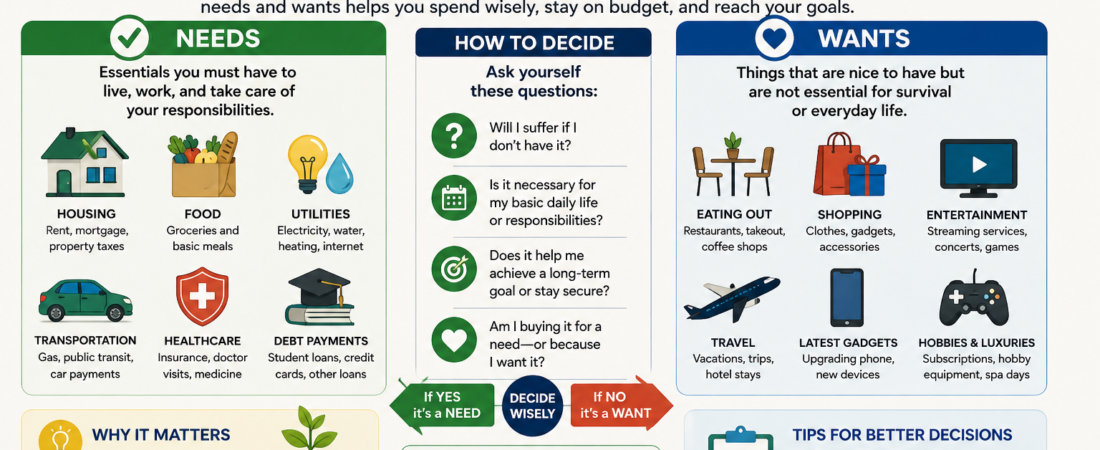
Making smart spending decisions starts with understanding the difference between what you need and what you want. This simple distinction can help you control unnecessary spending, build savings, reduce financial stress, and make better use of your income.
A need is generally something essential for your basic living, responsibilities, or financial obligations. A want is something you would like to have but can live without. The difference is not always obvious, though. What is a need for one person may be a want for another depending on their circumstances.
Learning how to identify both categories can make budgeting much easier.
What Is a Need?
A need is an expense that is necessary to maintain your basic quality of life or meet important responsibilities.
Common examples include:
- Housing
- Basic food
- Utilities
- Essential transportation
- Healthcare
- Basic clothing
- Insurance
- Required debt payments
For example, you need food, but you may not need to order an expensive meal from a restaurant.
You may need transportation to get to work, but you may not need the newest or most expensive vehicle.
The important question is whether the expense is genuinely necessary for your circumstances.
What Is a Want?
A want is something that you would like to purchase but could live without.
Examples can include:
- Eating at restaurants
- Entertainment
- Expensive clothing
- New electronics
- Luxury items
- Vacations
- Streaming services
- Hobbies
- Premium versions of products
Wants are not automatically bad. Everyone needs some room in their budget for enjoyment and personal interests.
The goal is simply to make sure wants do not prevent you from paying for important needs or reaching your financial goals.
Why the Difference Matters
When needs and wants are mixed together, it can become difficult to understand where your money is going.
You might believe that you are spending mostly on necessities when a significant portion of your income is actually going toward optional purchases.
Separating the two categories gives you more control.
If you need to reduce spending, you can usually look at wants first rather than immediately cutting essential expenses.
Some Expenses Can Be Both
Not every purchase fits neatly into one category.
For example, a smartphone may be a need if you rely on it for work, communication, or important services. However, buying the most expensive model available may be a want.
Similarly, clothing is a need, but designer clothing may be a want.
Transportation can also be complicated. You may need a vehicle, but you may not need a luxury vehicle with expensive features.
This is why the needs-versus-wants approach should be based on your actual circumstances rather than a fixed list.
Ask Yourself Before Buying
When you are unsure whether to make a purchase, ask yourself a few questions.
Do I really need this?
Consider whether the item solves an important problem or is simply something you want at the moment.
Can I afford it?
Even if something is useful, buying it may not be wise if it would interfere with essential expenses or financial goals.
Do I already own something that does the same job?
You may already have an alternative that works.
Will I still value this purchase later?
Thinking beyond the excitement of the moment can help reduce impulse spending.
Use the Waiting Rule
One effective way to reduce impulse purchases is to wait before buying.
For small purchases, you might wait a few hours or until the next day. For larger purchases, consider waiting several days or longer.
During the waiting period, ask yourself whether you still want or need the item.
If the desire disappears, you may have avoided an unnecessary expense. If you still believe the purchase is worthwhile and it fits your budget, you can make a more informed decision.
Prioritize Your Essential Expenses
When creating a budget, make sure your basic needs are covered first.
Housing, food, utilities, transportation, healthcare, and other important obligations should receive priority.
After those expenses are accounted for, you can decide how much money is available for wants and other financial goals.
This approach helps prevent discretionary spending from taking money away from essential responsibilities.
Create a Wants Budget
You do not have to eliminate every want to manage your finances responsibly.
Instead, consider creating a specific amount for discretionary spending each month.
For example, you might set aside money for restaurants, entertainment, hobbies, shopping, or other personal activities.
Having a defined amount allows you to enjoy your money without constantly wondering whether every purchase is affordable.
Watch Out for Lifestyle Inflation
As your income increases, it can be tempting to increase your spending immediately.
You may move into a more expensive home, upgrade your vehicle, buy more expensive clothing, or increase spending on entertainment.
Improving your lifestyle is not necessarily a problem, but if every income increase leads to higher expenses, you may struggle to build savings.
Consider directing at least part of an income increase toward savings, debt repayment, or other financial goals.
Compare the Long-Term Cost
A purchase should not always be judged by its price alone.
Consider the ongoing costs associated with it.
For example, buying a cheaper vehicle may not necessarily be less expensive if it requires frequent repairs or has high operating costs.
Similarly, a low-cost appliance may not be the best value if it needs to be replaced quickly.
When comparing purchases, consider durability, maintenance, operating costs, and how long the item is likely to remain useful.
Avoid Using Credit to Fund Wants
Credit can make it easy to purchase something before you actually have the money for it.
If you regularly use credit for discretionary purchases and carry balances, interest and fees can make those purchases much more expensive.
Before financing a want, consider whether you could save for it instead.
If you cannot comfortably afford something without taking on expensive debt, waiting may be the safer financial choice.
Think About Your Financial Goals
Spending decisions should be connected to your larger goals.
If you are trying to build an emergency fund, pay down debt, buy a home, or prepare for retirement, unnecessary spending may slow your progress.
This does not mean you should never enjoy your money. Instead, consider whether a purchase is worth giving up part of the progress you could make toward something more important to you.
Avoid Comparing Yourself With Others
Social media and advertising can make it appear that everyone is constantly buying new clothes, cars, phones, vacations, and other expensive items.
Remember that you usually do not know the full financial situation behind what you see.
Make spending decisions based on your own income, responsibilities, priorities, and goals rather than trying to match someone else’s lifestyle.
Make Spending More Intentional
Before making a purchase, think about what you are trying to accomplish with your money.
Intentional spending means choosing purchases because they provide genuine value rather than buying simply because something is on sale, trending, or being advertised.
You can still spend money on things you enjoy. The difference is that your spending becomes a deliberate choice instead of an automatic habit.
Conclusion
Understanding needs versus wants is a simple but powerful personal finance skill. Needs generally cover essential expenses, while wants are optional purchases that can improve your lifestyle but are not necessary.
The goal is not to eliminate wants completely. Instead, prioritize essential expenses, create room for enjoyable spending, avoid unnecessary debt, and connect your purchases to your financial goals.
By pausing before purchases and asking whether something is necessary, affordable, and valuable to you, you can make more thoughtful spending decisions and gain greater control over your money.