
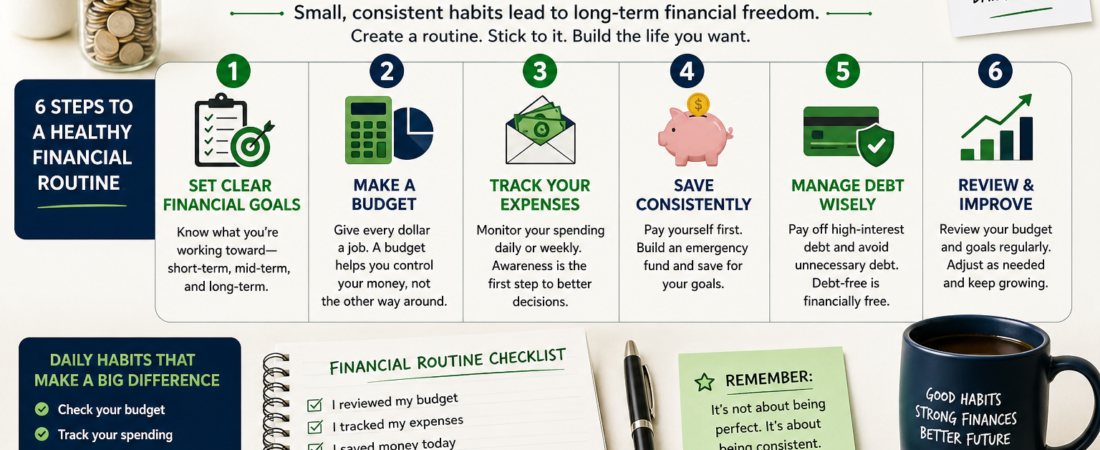
Managing money well is not only about how much you earn. It is also about the habits you develop around spending, saving, budgeting, and planning. A healthy financial routine can help you stay organized, avoid unnecessary financial stress, and make steady progress toward your goals.
You do not need to completely change your lifestyle overnight. The most effective financial routines are usually simple, realistic, and consistent. By creating a few regular habits and reviewing your finances regularly, you can become more confident about managing your money.
Here are practical steps for building a healthy financial routine.
1. Know Where Your Money Goes
The first step is understanding your financial situation.
Review your income and regular expenses. Look at your bank statements, bills, subscriptions, debt payments, and everyday purchases.
You do not need to track every detail forever, but spending awareness is important when building a new routine.
Once you know where your money is going, it becomes easier to identify unnecessary expenses and make informed decisions.
2. Create a Realistic Monthly Budget
A budget gives your money a purpose before you spend it.
Start by listing your expected monthly income and essential expenses. Then include savings, debt payments, and discretionary spending.
Your budget should reflect your real lifestyle. If you make the plan too restrictive, it may be difficult to maintain.
Instead of trying to create a perfect budget immediately, start with a simple plan and improve it as you learn more about your spending habits.
3. Check Your Finances Regularly
Set aside a specific time each week or month to review your finances.
During a weekly check-in, you might review recent transactions and make sure you are staying within your spending limits.
A monthly review can be more detailed. Look at your total income, expenses, savings, debt payments, and progress toward your financial goals.
Making financial reviews part of your routine can prevent small problems from becoming larger ones.
4. Automate Your Savings
Saving becomes easier when you do not have to remember to transfer money manually.
Consider setting up an automatic transfer to a savings account after receiving your income.
You can start with a small amount and increase it when your financial situation allows.
Automation helps turn saving from an occasional activity into a regular habit.
5. Build an Emergency Fund
Unexpected expenses are a normal part of life. Having money set aside for emergencies can help you handle them without relying entirely on credit or loans.
Start with an amount that feels achievable. Over time, work toward building a larger emergency reserve that suits your circumstances.
Keep emergency savings separate from money used for everyday spending when possible.
6. Pay Bills on Time
Late payments can create unnecessary fees and may cause other financial problems.
Create a system for keeping track of due dates. You can use calendar reminders, banking alerts, automatic payments, or a written checklist.
Make sure you have enough money available before scheduling automatic payments.
A simple bill-paying routine can make your finances more predictable.
7. Control Impulse Spending
Impulse purchases can make it difficult to stick to a budget.
Before buying something that was not planned, pause and ask yourself whether you actually need it.
For larger purchases, consider using a waiting period. Giving yourself time to think can help you determine whether the purchase is genuinely worthwhile.
You can also remove saved payment information from shopping websites if it makes spontaneous purchases too easy.
8. Review Your Subscriptions
Recurring payments can quietly consume part of your income.
Once a month, review your subscriptions and memberships. Check whether you are still using each service.
Cancel anything you no longer need or use, and make a note of annual subscriptions so they do not surprise you when they renew.
9. Set Specific Financial Goals
A financial routine is easier to maintain when you know what you are working toward.
Your goals might include:
- Building emergency savings
- Paying off debt
- Saving for a home
- Preparing for retirement
- Starting a business
- Saving for education
- Taking a vacation
Give each goal a specific target and, when appropriate, a timeframe.
Instead of saying, “I want to save more,” choose a clear amount and determine how much you need to set aside regularly.
10. Review Your Debt
Make debt management part of your regular financial routine.
Keep track of balances, interest rates, minimum payments, and due dates.
Always make required payments on time. If you have additional money available, you can consider putting extra funds toward higher-interest debt while continuing to meet your other obligations.
Avoid taking on new debt for purchases you do not need or cannot comfortably afford.
11. Give Yourself a Spending Allowance
A healthy financial routine should leave room for enjoyment.
Instead of trying to eliminate all discretionary spending, create a reasonable amount for entertainment, hobbies, dining out, or other personal activities.
Having money specifically set aside for wants can make it easier to follow your budget without feeling overly restricted.
12. Use a Simple Financial System
Your financial routine does not need to involve complicated spreadsheets.
You can use a notebook, spreadsheet, budgeting application, or another system that you understand and can maintain.
The most important information to track includes:
- Income
- Essential expenses
- Discretionary spending
- Savings
- Debt
- Financial goals
Keep your system simple enough that you will actually use it.
13. Have a Weekly Money Check-In
Choose one day each week for a short financial check-in.
Spend a few minutes reviewing your recent transactions and upcoming bills.
Ask yourself:
- How much have I spent this week?
- Are there any bills coming up?
- Am I staying within my budget?
- Did I make any unnecessary purchases?
- Am I still on track with my savings goals?
A short weekly check-in can keep you aware of your financial situation without requiring hours of work.
14. Have a Monthly Financial Review
Once a month, take a deeper look at your finances.
Compare your actual spending with your budget. Review your savings progress and debt balances.
Look for areas where you can improve. Perhaps you spent more than expected on dining out or discovered a subscription you no longer use.
Use these observations to make adjustments for the next month.
15. Increase Your Financial Knowledge
Financial habits become stronger when they are supported by knowledge.
Learn about topics that are relevant to your situation, such as budgeting, saving, credit, insurance, taxes, retirement planning, and investing.
Be careful when following financial advice online. Different strategies may be appropriate for different circumstances, and information that works for one person may not work for another.
For major or complicated financial decisions, consider seeking advice from an appropriately qualified professional.
16. Prepare for Irregular Expenses
Not every expense happens every month.
Car repairs, annual insurance payments, gifts, travel, school expenses, and home maintenance can all require money at different times.
Make a list of predictable irregular expenses and estimate how much they may cost. If possible, set aside money regularly so these expenses are easier to manage when they arrive.
17. Adjust Your Routine When Life Changes
Your financial routine should change when your circumstances change.
A new job, change in income, move, major purchase, marriage, new child, or other life event can affect your budget and priorities.
Review your financial plan whenever there is a significant change.
A routine that adapts to your life is more useful than one that stays fixed even when your circumstances are different.
18. Celebrate Progress
Financial improvement takes time, so recognize your progress along the way.
Paying off a debt, reaching a savings target, sticking to your budget, or reducing unnecessary spending are all meaningful achievements.
You do not need to make expensive purchases to celebrate. The goal is to recognize that consistent habits are producing results.
Conclusion
Building a healthy financial routine is about creating simple habits that you can maintain over time. Start by understanding your income and expenses, creating a realistic budget, tracking your spending, paying bills on time, saving regularly, and reviewing your progress.
You do not need to change everything at once. Choose a few habits, make them consistent, and gradually add more as you become comfortable.
The goal is not perfect money management. It is to develop a routine that helps you stay organized, make thoughtful spending decisions, prepare for unexpected expenses, and work steadily toward your financial goals.