
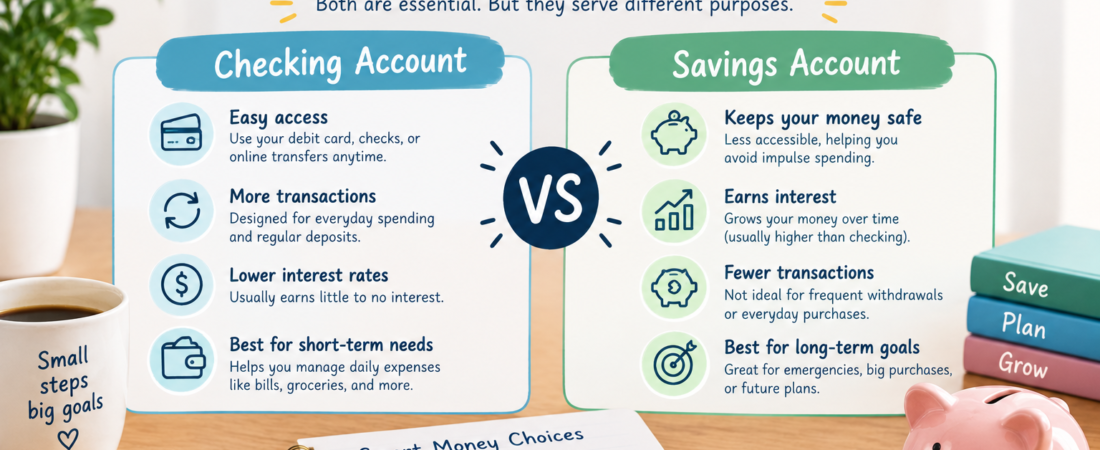
Managing your money becomes much easier when you understand where your money should be kept. Two of the most common bank accounts available are checking accounts and savings accounts. While both allow you to keep money safely at a financial institution, they serve different purposes.
A checking account is generally designed for everyday spending and regular transactions, while a savings account is mainly designed for setting money aside for future needs. Understanding the differences between these accounts can help you organize your finances, avoid unnecessary fees, and make better decisions about saving and spending.
What Is a Checking Account?
A checking account is a type of bank account designed for frequent transactions. People commonly use checking accounts to receive their income, pay bills, make purchases, and withdraw cash.
Most checking accounts provide access through a debit card. You may also be able to use checks, online banking, mobile banking, and electronic transfers.
For example, if your employer pays you every month, your paycheck can be deposited directly into your checking account. You can then use that money to pay rent, buy groceries, pay utility bills, and handle other regular expenses.
Because checking accounts are designed for frequent use, they are usually easy to access. However, some checking accounts may have monthly maintenance fees, overdraft fees, ATM fees, or other charges. Some financial institutions offer ways to avoid certain fees, such as maintaining a minimum balance or receiving qualifying direct deposits.
What Is a Savings Account?
A savings account is designed to help you set money aside for future expenses and financial goals. Instead of using it for everyday purchases, you can use a savings account to build an emergency fund, save for a vacation, prepare for a large purchase, or simply keep money available for the future.
Savings accounts commonly pay interest on the money deposited into them. The interest rate varies by financial institution and account type.
For example, if you regularly transfer $200 into a savings account each month, your balance can gradually grow. If the account pays interest, you may also earn additional money based on the account’s terms.
Savings accounts can also help reduce unnecessary spending because the money is kept separate from the funds you use for daily expenses.
Checking Account vs. Savings Account
Although both accounts hold your money, their features and purposes are different.
1. Main Purpose
The primary purpose of a checking account is everyday money management. It is useful for receiving income, paying bills, making purchases, and accessing cash.
The primary purpose of a savings account is to hold money that you intend to keep for future needs.
In simple terms, checking is generally for spending, while savings is generally for saving.
2. Accessibility
Checking accounts are usually designed for frequent access. You can commonly use a debit card, ATM, online banking, or electronic payments to access your money.
Savings accounts also allow you to access your money, but they may have different rules concerning withdrawals and transfers. The specific rules depend on the financial institution and account agreement.
If you need money for everyday purchases, a checking account is generally more convenient.
3. Interest Rates
Another major difference is the potential to earn interest.
Traditional checking accounts often pay little or no interest. However, some checking accounts do offer interest under specific conditions.
Savings accounts generally pay interest, allowing your deposited money to earn a return over time. The amount you earn depends on the account’s interest rate and your balance.
When comparing savings accounts, look at the annual percentage yield, or APY, rather than focusing only on the stated interest rate.
4. Debit Card Access
Checking accounts commonly come with debit cards. You can use a debit card to make purchases in stores, shop online, or withdraw money from an ATM.
Savings accounts are generally not designed for frequent debit card spending. Some financial institutions may provide ATM access, but the features vary.
Keeping your savings separate from your debit card spending can make it easier to avoid accidentally using money that you intended to save.
5. Bill Payments
Checking accounts are generally better suited to recurring payments. You can use them to pay rent, electricity bills, phone bills, subscriptions, insurance, and other regular expenses.
A savings account is generally not intended to be your main account for everyday bills.
Using a checking account for bills can make it easier to monitor how much money is available for your monthly expenses.
Why You May Want Both Accounts
You do not necessarily have to choose between a checking account and a savings account. Many people use both because they perform different jobs.
For example, you could have your paycheck deposited into your checking account. After receiving your income, you could automatically transfer a portion into your savings account.
Your checking account could then be used for everyday expenses, while your savings account could hold money for emergencies and future goals.
This system creates a simple separation between spending money and saving money.
Using a Savings Account for an Emergency Fund
An emergency fund is money set aside for unexpected expenses. These expenses might include car repairs, home repairs, unexpected bills, or a temporary loss of income.
A savings account can be a convenient place to keep an emergency fund because the money can remain separate from your regular spending account while potentially earning interest.
Start with a realistic savings goal. Even if you cannot save a large amount immediately, setting aside a small amount regularly can help you build your emergency fund over time.
What Should You Consider Before Opening an Account?
Before choosing a checking or savings account, compare the features and fees carefully.
Some factors to consider include:
- Monthly account fees
- Minimum balance requirements
- Interest rate and APY
- ATM access and fees
- Overdraft policies
- Transaction limitations
- Online and mobile banking features
- Direct deposit options
- Transfer fees
- Customer service
Do not assume that every account has the same rules. Read the account terms carefully so you understand how the account works before depositing your money.
How to Decide Which Account You Need
Your choice depends largely on what you want the account to accomplish.
If you need an account for receiving your paycheck, paying bills, using a debit card, and handling everyday expenses, a checking account may be appropriate.
If your goal is to set money aside for emergencies, future purchases, or other financial goals, a savings account may be more appropriate.
If you want to manage both spending and saving, consider using both types of accounts together.
Example of a Simple Money Management System
Suppose you receive $3,500 per month after taxes.
You could use your checking account for your regular expenses, including housing, food, transportation, and bills. You might then automatically transfer $500 to your savings account each month.
Over one year, you would have transferred $6,000 into savings, before considering any interest earned.
This approach makes saving a regular part of your financial routine rather than something you do only when you have extra money.
Final Thoughts
Checking accounts and savings accounts are both useful financial tools, but they are designed for different purposes. A checking account generally provides convenient access to money for everyday transactions, while a savings account helps you set money aside for future needs and may allow your money to earn interest.
Using both accounts can provide a simple way to organize your finances. Keep the money you need for regular expenses in your checking account and consider placing money intended for emergencies and future goals in a savings account.
Before opening either type of account, compare fees, interest rates, access options, and account requirements. Taking the time to understand these differences can help you choose accounts that fit your financial needs and make managing your money easier.