
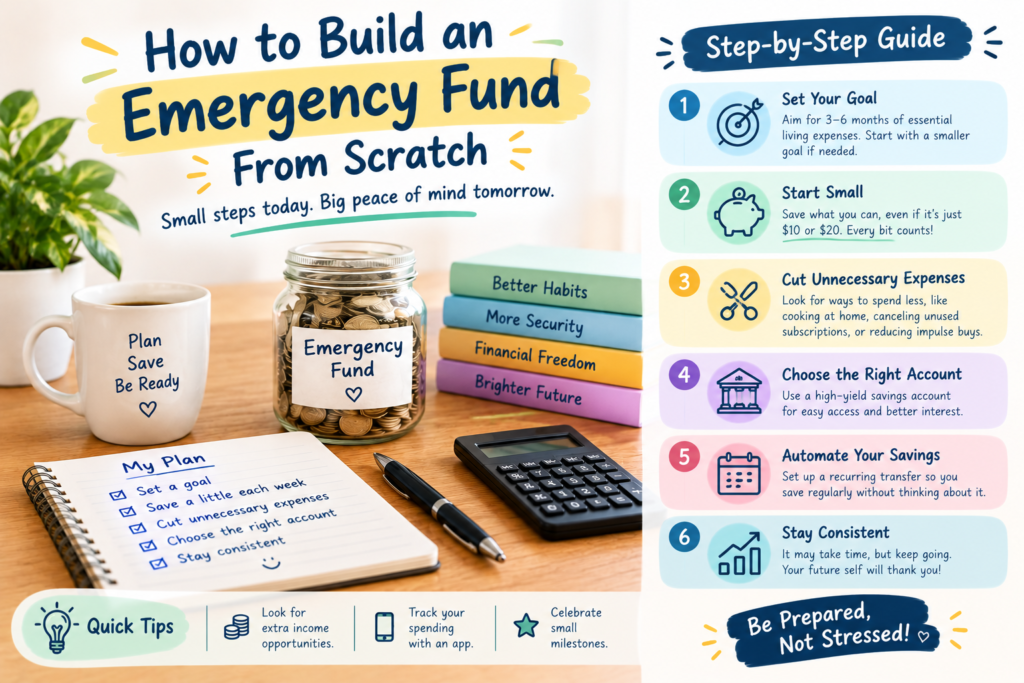
Building an emergency fund is one of the most useful steps you can take toward improving your financial stability. Unexpected expenses can happen at any time, from a sudden car repair to an unexpected medical bill or a temporary loss of income. Without savings, these situations can quickly create financial stress.
The good news is that you do not need a large amount of money to start an emergency fund. You can begin with whatever amount you can afford and gradually increase your savings over time. The key is to create a realistic plan and make saving a consistent habit.
1. Understand Why You Need an Emergency Fund
Before you start saving, understand what an emergency fund is designed to do.
An emergency fund is money set aside specifically for unexpected and necessary expenses. It should not normally be used for planned purchases, entertainment, vacations, or everyday spending.
Examples of emergencies can include:
- Unexpected car repairs
- Emergency home repairs
- Necessary medical expenses
- Unexpected travel
- Replacement of an essential appliance
- Temporary loss of income
- Other unavoidable financial emergencies
Knowing the purpose of your fund can make it easier to protect the money and avoid unnecessary withdrawals.
2. Set Your First Savings Goal
If you are starting with nothing, do not immediately focus on saving several months of expenses. A large goal can make the process seem impossible.
Instead, choose a small first target. For example, you could aim to save $500 or $1,000.
Once you reach your first target, you can continue building your fund. The important thing is to establish the habit of saving.
A small amount saved consistently is better than waiting until you have enough money to make a large deposit.
3. Calculate Your Essential Expenses
After reaching your first goal, calculate how much money you would need to cover your basic expenses.
Make a list of essential monthly costs such as:
- Rent or mortgage
- Utilities
- Groceries
- Transportation
- Insurance
- Minimum debt payments
- Essential healthcare costs
- Childcare
- Other necessary household expenses
Add these expenses together to determine your approximate monthly essential spending.
For example, if your essential expenses total $2,500 per month, three months of expenses would be $7,500.
This gives you a target to work toward, although your ideal emergency fund will depend on your personal circumstances.
4. Start With an Amount You Can Afford
One of the biggest mistakes people make is setting a savings goal that is too aggressive.
You do not have to save hundreds of dollars every month if your current budget does not allow it.
Start with an amount that you can maintain. That might be $10 per week, $25 per week, or $100 per month.
The exact amount is less important than consistency. Once your income increases or your expenses decrease, you can increase your savings contribution.
5. Automate Your Savings
Automation is one of the easiest ways to build an emergency fund.
Set up an automatic transfer from your checking account to your savings account. You can schedule the transfer to happen after each paycheck or on a specific day each month.
For example, if you get paid twice a month, you could automatically transfer $50 from each paycheck to savings. That would result in $100 saved per month without requiring you to remember to make the transfer.
Automatic saving can also reduce the temptation to spend money before you save it.
6. Create a Separate Savings Account
Consider keeping your emergency fund separate from your everyday spending money.
If your emergency savings sits in the same account you use for groceries, entertainment, and shopping, it may be easier to spend it accidentally.
A separate savings account creates a psychological and practical barrier between your emergency money and your regular spending.
Choose an account that provides reasonable access when you need the money while offering features that fit your needs.
7. Reduce Unnecessary Expenses
You do not have to completely change your lifestyle to build an emergency fund. Look for a few expenses that you can reduce without making your budget unrealistic.
For example, you could:
- Cancel subscriptions you rarely use
- Cook at home more often
- Reduce impulse purchases
- Compare insurance or service costs
- Limit unnecessary online shopping
- Look for lower-cost entertainment
- Reduce frequent takeout orders
Even saving an extra $20 or $50 per month can help increase the speed at which you build your emergency fund.
8. Use Extra Income
Another way to build your emergency fund faster is to use some of your additional income.
Extra money could come from overtime, freelance work, a side business, bonuses, cash gifts, or selling items you no longer need.
You do not necessarily have to save all of your extra income. For example, you might decide to put half toward your emergency fund and use the other half for another financial priority.
The goal is to use occasional extra money to make meaningful progress without depending on it for your regular budget.
9. Save Unexpected Money
Sometimes you receive money that you were not expecting. Instead of immediately spending all of it, consider putting some or all of it into your emergency fund.
Examples include tax refunds, work bonuses, gifts, rebates, or money from selling unused possessions.
A single large deposit can give your savings a significant boost.
10. Avoid Using the Fund for Non-Emergencies
Building an emergency fund requires discipline. Once you have money saved, avoid using it for expenses that could be planned in advance.
For example, if you want a new laptop, vacation, or furniture, consider creating a separate savings goal for that purchase.
Keeping different savings goals separate can help protect your emergency fund.
11. Rebuild the Fund After Using It
Eventually, you may need to use your emergency savings. That does not mean you failed.
The fund exists specifically for unexpected situations. If you use $1,000 for an emergency, focus on rebuilding the amount afterward.
You can temporarily increase your savings contributions or direct extra income toward restoring the balance.
Once the emergency has passed, return to your normal saving routine and continue working toward your target.
12. Keep Increasing Your Savings Goal
Your first goal does not have to be your final goal.
You might start with $500, then increase your target to $1,000. After that, you could work toward covering three months of essential expenses.
As your income, expenses, and responsibilities change, review your emergency fund periodically.
A larger household or less predictable income may require a larger financial cushion, while someone with fewer financial responsibilities may have different needs.
13. Track Your Progress
Tracking your progress can make saving more motivating.
You can use a spreadsheet, budgeting app, notebook, or simple savings tracker.
For example:
Goal: $5,000
Current savings: $2,000
Remaining: $3,000
Seeing your progress can help you stay focused and recognize how far you have already come.
Common Mistakes to Avoid
When building an emergency fund, avoid setting an unrealistic goal, relying only on leftover money, or keeping your emergency savings in an account that makes it too easy to spend.
Another common mistake is stopping after reaching a small initial target. A $500 or $1,000 emergency fund is a useful beginning, but your long-term target may need to be larger depending on your circumstances.
Most importantly, do not compare your savings progress with someone else’s. Your income, expenses, and financial responsibilities are unique.
Final Thoughts
Building an emergency fund from scratch may seem difficult, especially if you are starting with little or no savings. However, you can make the process manageable by starting small and saving consistently.
Set an initial goal, calculate your essential expenses, automate your savings, reduce unnecessary spending, and use extra income when available. Keep your emergency savings separate from everyday spending and replenish the fund after using it.
You do not need to build your entire emergency fund overnight. Every deposit brings you closer to having a financial cushion that can help you handle unexpected expenses with greater confidence. The most important step is to start saving today and continue building the habit over time.