
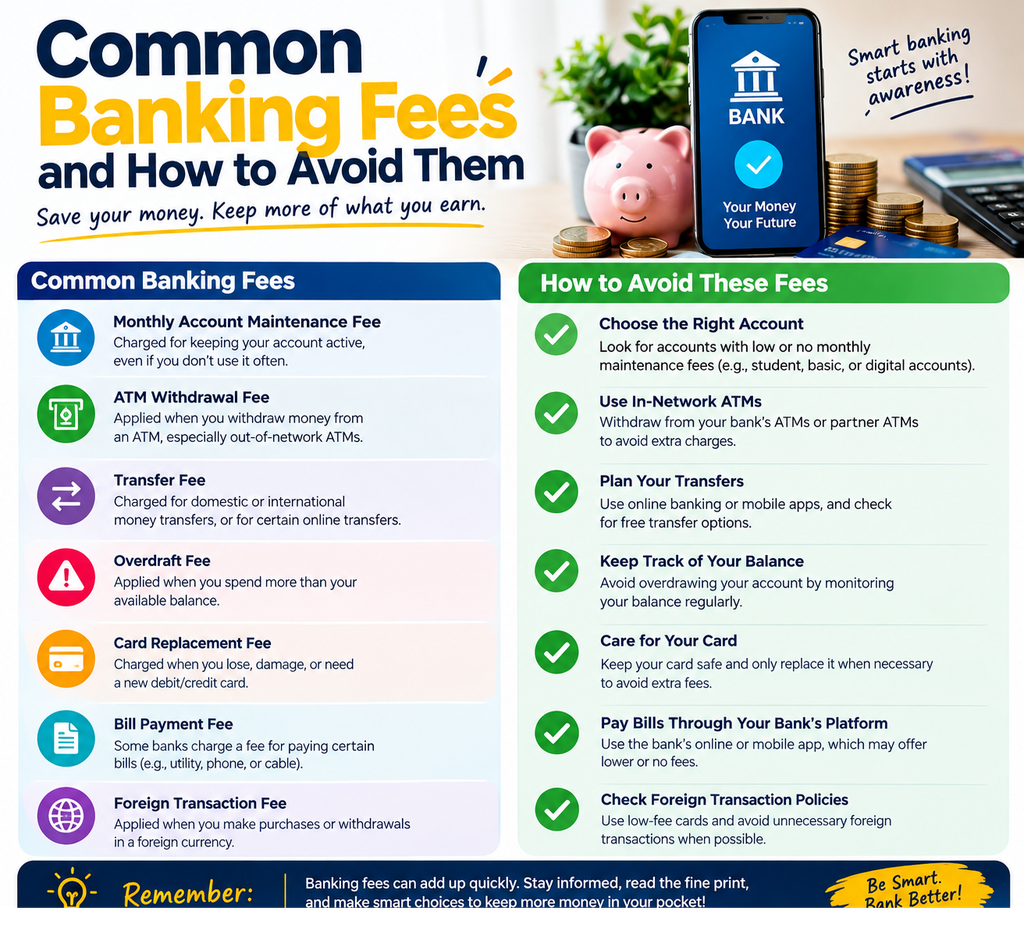
Bank accounts make it easier to manage your money, pay bills, receive income, and save for the future. However, banking services are not always free. Banks and credit unions may charge different types of fees for certain services or account activities.
The good news is that many common banking fees can be avoided by understanding your account terms and changing a few everyday habits. Learning how these fees work can help you keep more of your money and make better banking decisions.
What Are Banking Fees?
Banking fees are charges a financial institution may apply when you use certain services or when your account doesn’t meet specific requirements.
Some fees are charged for using particular services, while others may apply when you don’t maintain a required balance or make certain transactions.
The exact fees vary between financial institutions and account types, so it’s important to review your bank’s fee schedule.
1. Monthly Maintenance Fees
A monthly maintenance fee is a recurring charge for keeping certain checking or savings accounts open.
For example, a bank might charge a monthly fee unless you maintain a minimum balance or meet another qualifying requirement.
How to Avoid It
Look for accounts that don’t charge monthly maintenance fees. Some banks waive the fee if you meet conditions such as:
- Maintaining a minimum balance
- Receiving qualifying direct deposits
- Making a certain number of transactions
- Meeting age or account eligibility requirements
Before opening an account, understand exactly what is required to avoid the fee.
2. Overdraft Fees
An overdraft can happen when you spend more money than is available in your checking account and the bank pays the transaction.
Depending on the account and institution, an overdraft may result in a fee.
How to Avoid It
Keep track of your account balance and upcoming payments. You can also use:
- Low-balance alerts
- Automatic balance notifications
- Account monitoring through your banking app
- Linked savings accounts, where available
- Overdraft protection options
Don’t rely entirely on your available balance. Pending transactions can affect how much money is actually available for spending.
3. Non-Sufficient Funds Fees
A non-sufficient funds, or NSF, fee can occur when a transaction is presented to an account without enough money available to cover it and the transaction is rejected or returned.
How to Avoid It
Maintain enough money in your checking account to cover scheduled payments. Keeping a small buffer can also help protect against unexpected withdrawals.
For example, instead of allowing your checking balance to fall to $0, you could maintain a personal cushion that you don’t normally spend.
4. ATM Fees
Using an ATM outside your bank’s network may result in an ATM fee. In some cases, both the ATM operator and your financial institution may charge fees.
How to Avoid It
Use ATMs that belong to your bank’s network whenever possible. You can also check whether your bank offers ATM fee reimbursements.
Before withdrawing money, look at the ATM screen carefully for any surcharge information.
5. Out-of-Network ATM Fees
Some banks charge a separate fee when you use another institution’s ATM.
For people who frequently travel or live far from their bank’s branches, these fees can add up.
How to Avoid It
Use your bank’s mobile app or website to find participating ATMs. Some accounts also offer larger ATM networks or reimburse certain fees.
Planning cash withdrawals instead of making many small withdrawals can also reduce the number of times you need to use an ATM.
6. Foreign Transaction Fees
Some banks and card issuers charge fees when you use a debit or credit card for purchases made outside the country or in a foreign currency.
These charges can become noticeable during international travel.
How to Avoid It
If you travel internationally, compare accounts and cards based on their foreign transaction policies before your trip. Some products offer no foreign transaction fees, while others may charge a percentage of each purchase.
Also check your bank’s policies before using your card abroad.
7. Wire Transfer Fees
Banks may charge fees for sending or receiving wire transfers. The amount can depend on whether the transfer is domestic or international.
How to Avoid It
If you don’t need a wire transfer, consider whether another payment method is available and appropriate. For regular transfers, compare the cost and speed of alternatives offered by your bank.
If you frequently send money internationally, compare financial institutions based on their transfer fees and exchange-rate policies.
8. Excessive Transaction Fees
Certain savings accounts may have transaction limitations or fees associated with specific types of withdrawals or transfers, depending on the account and current rules.
How to Avoid It
Use checking accounts for frequent spending and savings accounts primarily for saving. Review your account’s current transaction rules so you know what activities may result in fees.
9. Paper Statement Fees
Some financial institutions may charge customers for receiving paper statements instead of electronic statements.
How to Avoid It
Switching to electronic statements can eliminate this type of fee when your bank offers a fee-free paperless option.
Online statements are also convenient because you can usually access them through your banking app or website.
10. Check and Deposit Fees
Some accounts may charge fees for certain check-related services, cashier’s checks, money orders, or other specialized transactions.
How to Avoid It
Review the cost before requesting a service. If you regularly need cashier’s checks or similar services, compare account options to find one that offers the services you need at a reasonable cost.
How to Find Out What Your Bank Charges
The easiest way to understand your banking fees is to review your account’s fee schedule and disclosures.
Don’t assume that all accounts at the same bank have identical fees. Checking accounts, savings accounts, and premium accounts may have different terms.
You can also contact your bank and ask specific questions, such as:
- Does this account have a monthly fee?
- How can I avoid the fee?
- Does the bank charge out-of-network ATM fees?
- Are there overdraft or NSF fees?
- Are there fees for incoming or outgoing transfers?
- Are there foreign transaction fees?
- Are there minimum balance requirements?
Getting clear answers can help you avoid surprises.
Set Up Banking Alerts
One of the easiest ways to prevent unnecessary fees is to use account alerts.
Depending on your bank, you may be able to receive notifications when:
- Your balance falls below a certain amount
- A large transaction occurs
- A deposit is received
- A payment is due
- Your balance changes
- A transaction is declined
These alerts can help you identify potential problems before they become expensive.
Compare Banks Before Opening an Account
You don’t have to stay with an account simply because you’ve had it for years.
When comparing banks or accounts, look at the complete fee structure rather than focusing on one feature.
Consider:
Monthly fees: Is there a recurring charge?
ATM access: Can you easily find fee-free ATMs?
Minimum balance: Is there a required balance?
Overdraft policies: What happens if you spend more than your available balance?
Transfer fees: Are common transfers free?
Account features: Does the account provide the tools you actually need?
A fee-free account that meets your needs may save you more money over time than an account with expensive features you rarely use.
Create a Small Banking Buffer
Maintaining a small cushion in your checking account can help prevent overdrafts and declined payments.
For example, if your normal monthly expenses are $2,000, you might choose to keep an additional amount available as a personal buffer.
The exact amount depends on your income and expenses. The goal is simply to avoid operating so close to zero that one unexpected charge creates a problem.
Review Your Fees Regularly
Banking fees can change when account terms change, so review your statements periodically.
Look for unfamiliar charges and ask your financial institution about anything you don’t understand. If you notice recurring fees you don’t need, consider changing your account or banking habits.
You can also compare competing accounts from time to time to make sure your current account still fits your needs.
Final Thoughts
Common banking fees can quietly reduce your money if you don’t pay attention to them. Monthly maintenance fees, ATM fees, overdraft charges, transfer fees, and other account costs can often be reduced or avoided with careful planning.
Start by understanding your bank’s fee schedule. Then use practical strategies such as choosing a low-fee account, maintaining a checking account buffer, using in-network ATMs, setting up alerts, and reviewing your statements regularly.
Banking doesn’t have to be expensive. By understanding how fees work and choosing accounts carefully, you can reduce unnecessary costs and keep more of your money working toward your financial goals.