
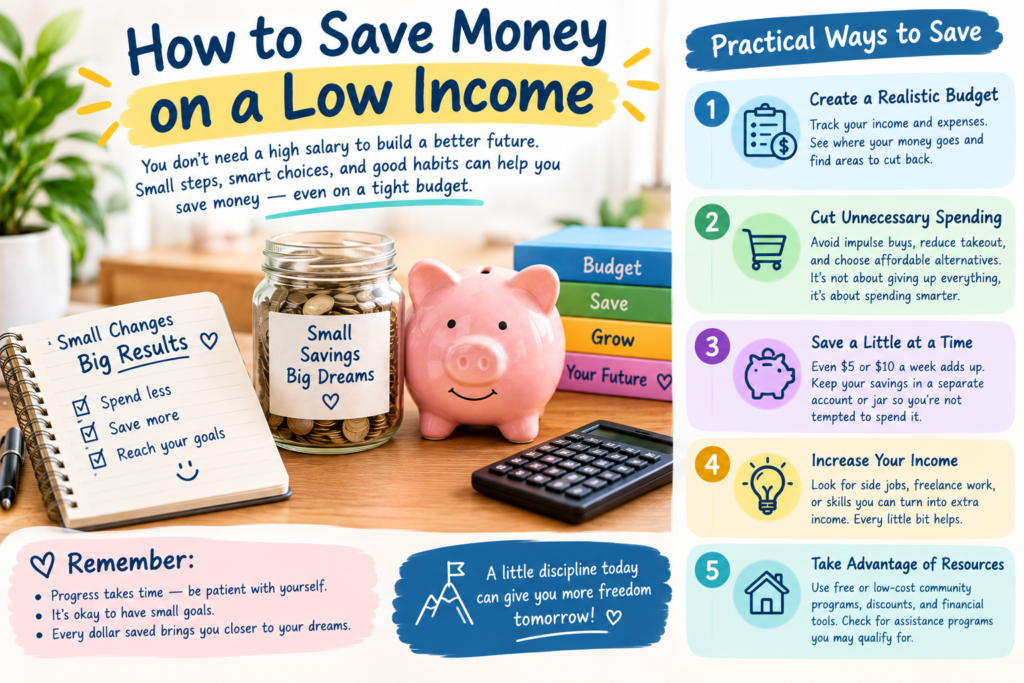
Saving money can feel difficult when your income is limited. After paying for housing, food, transportation, utilities, and other essential expenses, there may seem to be little or nothing left to put into savings. However, saving on a low income is still possible when you focus on realistic goals, control unnecessary expenses, and develop consistent financial habits.
You do not need to save a large amount of money at once. Even small amounts can become meaningful over time. The goal is to create a system that works with your current income rather than trying to follow a savings plan that is unrealistic for your situation.
1. Start by Understanding Your Income and Expenses
The first step toward saving money is knowing exactly how much money comes in and where it goes.
Write down all sources of monthly income. Then list your essential expenses, including:
- Rent or mortgage
- Utilities
- Groceries
- Transportation
- Insurance
- Debt payments
- Healthcare
- Childcare
- Other necessary expenses
After listing your essentials, look at flexible and non-essential spending. This may include entertainment, subscriptions, takeout, shopping, and other optional purchases.
Knowing your actual spending patterns can help you identify areas where small changes may be possible.
2. Create a Realistic Budget
A budget does not have to be complicated. Its purpose is to give your money a plan.
Start by covering your essential expenses. Then decide how much you can reasonably put toward savings, debt repayment, and optional spending.
If your income is limited, do not create a budget based on what you wish you could save. Create one based on what you can realistically maintain.
Even saving $10 or $20 per week can be a useful starting point.
3. Set a Small Savings Goal
A large savings target can feel overwhelming when money is tight. Instead, start with a small goal.
For example, you might first aim to save $100, then $250, and eventually $500 or $1,000.
Having smaller milestones can make the process feel more achievable.
Once you reach one goal, set another. Over time, these smaller amounts can help you build an emergency fund and create greater financial flexibility.
4. Automate Small Savings Transfers
If your bank allows automatic transfers, consider scheduling a small amount to move into savings regularly.
For example, you could transfer $10 every week or $25 every payday.
The amount does not need to be large. The purpose is to make saving a regular habit.
If your income changes from month to month, you may prefer to make manual transfers based on what you can afford after covering your essential expenses.
5. Reduce Unnecessary Expenses
When money is limited, small spending decisions become more important.
Look for expenses that you can reduce without affecting essential needs.
You might:
- Cancel unused subscriptions
- Cook more meals at home
- Reduce takeout orders
- Compare prices before buying
- Buy generic products when appropriate
- Avoid unnecessary impulse purchases
- Use free entertainment options
- Reduce convenience fees
You do not need to eliminate every enjoyable activity. The goal is to find spending that provides little value and redirect some of that money toward your financial goals.
6. Plan Your Grocery Spending
Food is an essential expense, but grocery costs can often be managed with planning.
Before shopping, create a list based on meals you actually plan to prepare. Check what you already have at home and avoid buying items simply because they look appealing.
Compare prices and consider store brands where they meet your needs.
Planning meals around affordable ingredients can also reduce the amount you spend on takeout and last-minute food purchases.
7. Avoid Impulse Purchases
Impulse spending can make saving difficult, especially when individual purchases seem inexpensive.
Before buying something that is not essential, give yourself time to think about it.
For larger purchases, consider waiting a day or longer before making a decision. Ask yourself whether you need the item, whether it fits your budget, and whether there is a less expensive alternative.
Delaying a purchase does not mean you can never buy something you want. It simply gives you time to make a more deliberate decision.
8. Look for Ways to Increase Your Income
Saving is only one part of improving your finances. If your expenses are already close to your income, finding ways to increase your income may provide more room in your budget.
Depending on your circumstances, possibilities could include:
- Overtime
- Freelance work
- Selling unused items
- Part-time work
- Online work
- Developing a new skill
- Negotiating pay when appropriate
You do not have to use every extra dollar for savings. However, directing a portion of additional income toward savings can help you reach your goals faster.
9. Save Unexpected Money
When you receive money that was not included in your normal budget, consider saving at least part of it.
This might include a cash gift, bonus, refund, or money earned from selling something you no longer need.
For example, if you receive an unexpected $200, you could put $100 into savings and use the remaining $100 for another purpose.
There is no single rule for how much you should save. The important thing is to use occasional extra money as an opportunity to strengthen your financial position.
10. Build an Emergency Fund Slowly
An emergency fund can be particularly valuable when your income is limited because an unexpected expense can have a significant impact on your budget.
Start with a small target, such as $500 or $1,000, and increase it gradually.
Eventually, you may want to build enough savings to cover several months of essential expenses, depending on your income stability and financial responsibilities.
Do not feel discouraged if building the fund takes a long time. Consistent progress matters.
11. Avoid Comparing Your Finances With Others
It can be easy to feel behind when you see other people spending money on expensive cars, vacations, clothing, or entertainment.
Remember that you do not know their complete financial situation.
Focus on your own income, expenses, goals, and progress.
Saving $25 may be a significant achievement for one person and insignificant for another. What matters is building habits that fit your circumstances.
12. Use Separate Savings From Everyday Spending
Keeping your savings separate from your spending money can make it easier to protect your progress.
Consider using a separate savings account for your emergency fund or other financial goals.
When your savings are not sitting in the same account you use for everyday purchases, you may be less likely to spend the money accidentally.
13. Track Your Progress
Tracking your savings can help you stay motivated.
You can use a simple notebook, spreadsheet, budgeting app, or savings tracker.
For example:
Goal: $1,000
Current savings: $350
Remaining: $650
Seeing the number increase can remind you that small contributions are adding up.
14. Be Patient With Yourself
Financial improvement does not happen overnight.
There may be months when you cannot save anything because of an unexpected expense. That does not mean you have failed.
When your situation improves, return to your savings routine.
The goal is not perfection. The goal is to develop habits that gradually improve your financial position.
Final Thoughts
Saving money on a low income can be challenging, but it is not impossible. The key is to focus on realistic steps rather than trying to make dramatic changes that are difficult to maintain.
Start by understanding your income and expenses, create a practical budget, reduce unnecessary spending, and set small savings goals. Automate savings when possible and look for opportunities to increase your income.
Most importantly, do not underestimate small amounts. Saving $10, $20, or $50 consistently can help you build an emergency fund and develop valuable financial habits.
Your financial situation may change over time, and your savings strategy can change with it. Start where you are, save what you reasonably can, and continue making progress one step at a time.