
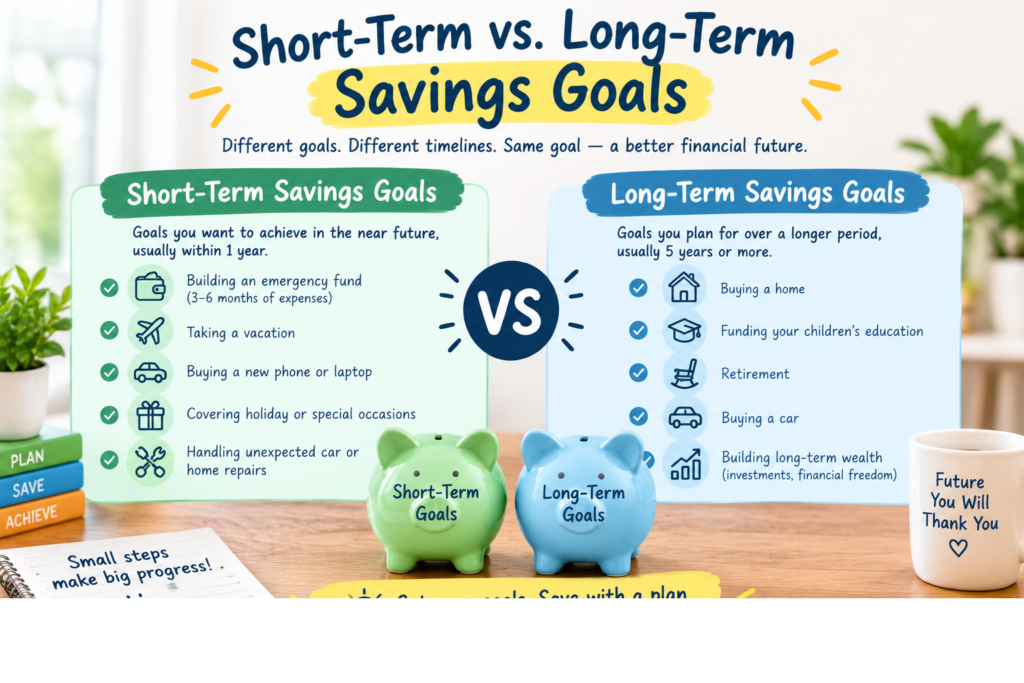
Saving money becomes much easier when you know exactly what you are saving for. Instead of simply putting money aside without a clear purpose, setting specific savings goals can help you stay organized, motivated, and focused.
Savings goals can generally be divided into two categories: short-term goals and long-term goals. Both are important, but they have different time frames, purposes, and strategies.
Understanding the difference between short-term and long-term savings goals can help you decide how much to save, where to keep your money, and how to plan for the future.
What Are Short-Term Savings Goals?
Short-term savings goals are financial goals that you expect to achieve within a relatively short period. Depending on your situation, a short-term goal may take a few weeks, several months, or a few years.
Examples of short-term savings goals include:
- Saving for a vacation
- Buying new furniture
- Paying for holiday expenses
- Building an initial emergency fund
- Saving for a car repair
- Preparing for a planned purchase
- Paying an upcoming annual bill
The exact time frame depends on the goal. What matters is that you expect to need the money relatively soon.
Because you may need the money quickly, short-term savings generally prioritize accessibility and stability.
What Are Long-Term Savings Goals?
Long-term savings goals are goals that may take several years or even decades to achieve.
Examples include:
- Buying a home
- Funding education
- Building retirement savings
- Starting a business
- Reaching a major financial milestone
- Building long-term wealth
Because these goals have a longer time horizon, you may have more opportunities to consider different financial strategies. However, the appropriate approach depends on your goals, risk tolerance, time frame, and individual financial circumstances.
Key Difference: Time Frame
The most obvious difference between short-term and long-term savings is how soon you need the money.
If you need the money within a few months, you generally want to prioritize keeping it accessible and avoiding unnecessary risk.
If you are saving for something many years away, you have more time to allow your money to potentially grow.
For example, saving $2,000 for a vacation next summer is very different from saving $200,000 for retirement several decades from now.
Short-Term Savings Should Be Easy to Access
When saving for a short-term goal, accessibility is often important.
A savings account can be useful for short-term goals because your money can remain separate from everyday spending while still being accessible when you need it.
You may also earn interest depending on the account.
The key is to avoid putting money needed in the near future into something that could experience significant fluctuations in value or be difficult to access when the money is needed.
Long-Term Savings Can Focus on Growth
Long-term goals give your money more time to potentially grow.
For example, someone saving for retirement may have decades before the money is needed. This longer period can allow them to consider investment options that may offer higher potential returns but also carry greater risk.
Investments can lose value, so they are not the same as guaranteed savings. The right approach depends on the individual and the specific goal.
The longer time horizon can provide more opportunity to recover from temporary market declines, although there are no guarantees.
How to Set a Short-Term Savings Goal
A good short-term savings goal should be specific and measurable.
Instead of saying, “I want to save more money,” create a clear target.
For example:
Goal: Save $1,200 for a vacation.
Time frame: 12 months.
Monthly target: $100.
This makes the goal easier to understand and track.
If you save $100 every month for 12 months, you will contribute $1,200, before considering any interest earned.
How to Set a Long-Term Savings Goal
Long-term goals can seem overwhelming because the final target may be very large.
Breaking the goal into smaller milestones can make it easier to manage.
For example, if your long-term goal is to save $60,000 over 10 years, you can calculate how much you would need to contribute each year or month.
You can then review your progress regularly and adjust your contributions as your income or financial situation changes.
For very long-term goals such as retirement, factors such as investment returns, inflation, taxes, and changing income can affect how much you ultimately need.
Create Separate Savings Accounts for Different Goals
Keeping all your savings in one account can make it difficult to know how much money is available for each purpose.
You can make things easier by separating your goals.
For example, you might have:
- Emergency savings
- Vacation savings
- Home savings
- General savings
Some banks also provide savings tools that allow you to create separate categories or savings goals within one account.
Separating your goals can help you avoid accidentally spending money that was intended for something else.
Prioritize Your Savings Goals
You may have several goals at the same time. When this happens, decide which goals are most important.
Emergency savings and essential financial needs may deserve attention before optional purchases.
After establishing a basic emergency fund, you can work toward other short-term and long-term goals based on your circumstances.
Prioritizing does not mean ignoring your other goals. It simply gives your money a clear order of importance.
Automate Your Savings
Automation can make both short-term and long-term saving easier.
You can set up automatic transfers from your checking account to your savings account after receiving your paycheck.
For example, you might automatically transfer $200 per month toward short-term goals and contribute another amount toward long-term savings.
Automation reduces the chance that you will spend the money before saving it.
Review Your Goals Regularly
Your financial goals can change.
You may get a new job, have a change in income, move to a new home, start a family, or develop new priorities.
Review your savings goals every few months. Ask yourself:
- Am I saving enough?
- Is my goal still realistic?
- Has my time frame changed?
- Do I need to increase or decrease my contributions?
- Am I keeping each goal in an appropriate place?
Regular reviews allow you to make adjustments before small problems become larger ones.
Avoid Mixing Savings With Everyday Spending
One simple way to improve your savings habits is to keep goal-based savings separate from money intended for everyday purchases.
If all your money is in one checking account, it can be tempting to spend more than planned.
Using separate savings accounts or clearly defined savings categories can make it easier to see how much money you have available for each goal.
Short-Term and Long-Term Goals Can Work Together
You do not have to choose between short-term and long-term savings.
In fact, having both can create a balanced financial plan.
For example, you might save for a vacation in the next year while also contributing regularly toward retirement.
The key is to create a budget that allows you to work toward multiple goals without neglecting your essential expenses.
Final Thoughts
Short-term and long-term savings goals serve different purposes, but both can play an important role in financial planning.
Short-term goals focus on expenses you expect to face relatively soon, such as vacations, repairs, or planned purchases. Long-term goals focus on major future objectives such as buying a home, funding education, or preparing for retirement.
The best approach is to give each goal a clear target, time frame, and savings strategy. Automate contributions where possible, keep your goals organized, and review your progress regularly.
You do not have to achieve every financial goal at once. By breaking large goals into smaller steps and consistently putting money aside, you can make steady progress toward both your immediate needs and your long-term financial future.