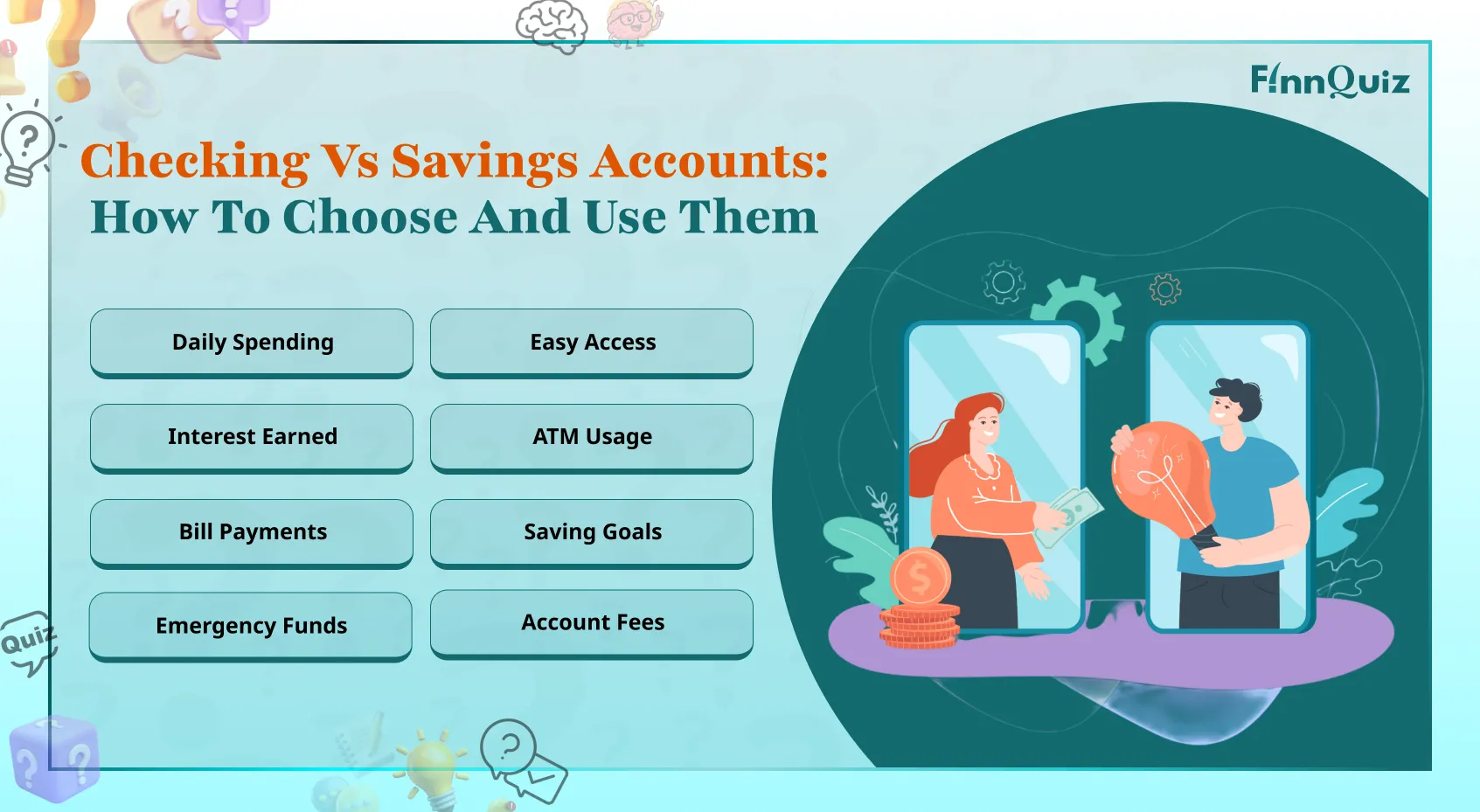
A checking account is for daily spending—paying bills, buying groceries, and getting cash from ATMs. A savings account is for money you do not need immediately—emergency funds, vacation savings, or future goals. The smart move is to use both: keep just enough in checking for near‑term expenses, and move the rest into savings where it can earn interest and stay out of temptation’s way. This guide explains how each account works, how to pick the right ones, avoid common fees, and make them work together to build your financial security.
Account Terms That Change the Real Cost
- Checking account: A transaction account designed for everyday spending, commonly offering debit-card access and bill pay. Fees, transaction limits, and interest vary by institution.
- Savings account: An account for storing money, earning interest, and limiting access to encourage saving. Often has withdrawal limits and higher interest than checking.
- Annual Percentage Yield (APY): The total interest you earn in a year, including compounding. Higher APY means your money grows faster.
- Monthly maintenance fee: A flat fee charged each month for keeping the account open. Often waived if you meet minimum balance or direct deposit requirements.
- Overdraft fee: A charge some institutions impose when they authorize a transaction that exceeds the available balance. Amounts and policies vary, and some accounts decline transactions or provide lower-cost alternatives.
- ATM fee: A charge for using an out‑of‑network ATM. Usually $2–$5 from the ATM owner plus an additional fee from your bank.
- FDIC insurance: Federal deposit insurance that protects your money up to $250,000 per depositor, per bank, per ownership category. Credit unions offer similar NCUA coverage.
- Direct deposit: An electronic transfer of your paycheck or other regular income directly into your account. Often used to waive monthly fees.
How Checking and Savings Accounts Work
Checking accounts are built for frequent transactions such as deposits, bill payments, transfers, debit-card purchases, and ATM withdrawals. Account agreements can still impose fees, daily limits, or transaction restrictions. Some checking accounts pay interest, but the rate must be compared alongside fees and balance requirements.
Savings accounts are designed to hold funds that are not needed for routine spending. Rates are variable and can change quickly, so compare the current APY on the day you apply instead of relying on a rate quoted in an article. Federal Regulation D no longer requires the former six-transfer limit, but an institution may impose its own withdrawal limits or fees. Read the account agreement before opening it.
Eligible deposit accounts at an FDIC-insured bank are generally insured to at least $250,000 per depositor, per insured bank, for each ownership category. Federally insured credit unions provide similar NCUA coverage. Coverage depends on the institution, ownership category, and total deposits, so verify the institution and use the official FDIC or NCUA estimator when balances are substantial.
Step‑by‑Step: How to Choose and Set Up Your Accounts
Follow these steps to get the right accounts for your needs and avoid unnecessary fees.
- Step 1: Decide what functions you need. Many people use checking for transactions and savings for reserves, but a particular combination is not mandatory. List your needs for cash access, bill pay, separation of savings, deposit insurance, and interest before comparing accounts.
- Step 2: Compare checking accounts. Look at monthly fees and how to waive them (direct deposit, minimum balance). Check ATM access—does the bank have a large fee‑free network? Review digital features: mobile deposit, bill pay, and alerts. Avoid accounts with high overdraft fees.
- Step 3: Compare savings accounts. Focus on APY—online banks usually offer the best rates. Check for monthly fees and minimum balance requirements. Ensure easy transfers to and from your checking account (at the same bank or via ACH).
- Step 4: Open your accounts. You can do this online or in person. You will need your Social Security number, a government‑issued ID, and an initial deposit (if required). Link your checking and savings accounts to enable easy transfers.
- Step 5: Set up direct deposit. Have your employer deposit your paycheck into your checking account. Many banks waive monthly fees for accounts with direct deposit.
- Step 6: Automate your savings. Schedule a recurring transfer from checking to savings on payday—this is the "pay yourself first" principle. Even $25 per paycheck adds up.
- Step 7: Enable low‑balance alerts. Set up text or email alerts to notify you when your checking balance drops below a certain amount. This helps avoid overdrafts.
- Step 8: Review your statements monthly. Check every transaction, fee, and interest earned. Reconcile with your own records to catch errors.
Detailed Numerical Examples
Example 1: The Cost of Keeping Money in Checking
Hypothetical rate comparison: $5,000 at 0.01% APY earns about $0.50 in one year, while the same balance at an assumed 4.50% APY earns about $225. These rates are calculation inputs, not current offers. Substitute the APYs displayed by the institutions you are comparing.
Example 2: Avoiding Monthly Fees
A checking account charges a $12 monthly maintenance fee, but waives it if you maintain a $1,500 minimum balance or have $500 in direct deposits each month. You have direct deposit of $2,000, so the fee is waived automatically. If you switched to a job with no direct deposit and your balance fell below $1,500, you would pay $144 per year. By switching to a fee‑free online checking account, you save that $144 annually.
Example 3: Overdraft Fee Cost
An overdraft fee is $35 per transaction. If you have three transactions while overdrawn, that is $105 in fees—plus the amount you owe. By setting up low‑balance alerts and linking your savings account for overdraft protection (often a transfer fee of $10 or free at some banks), you can avoid those charges entirely.
Worked Example: Separating Bills From Short-Term Savings
In this hypothetical example, a worker uses one checking account for everything. Of a $2,000 balance, $1,500 is needed for bills and $500 is intended for short-term savings. A separate savings account could make those amounts easier to distinguish.
The worker compares current disclosures and chooses a checking account with no monthly fee under the expected usage pattern, suitable ATM access, and useful alerts. The linked savings account is verified as federally insured and has no monthly fee; its variable APY is recorded on the comparison date.
She sets up direct deposit of her $3,800 paycheck into checking. She schedules an automatic transfer of $400 to savings on payday (about 10.5% of her income). She enables low‑balance alerts at $200.
When her first statement arrives, she reviews it: she sees a $10 monthly maintenance fee—she did not meet the direct deposit requirement because her first paycheck took an extra day. She calls the bank; they waive it as a courtesy. She also notices a $2.50 ATM fee for using an out‑of‑network ATM. She learns to use only in‑network machines going forward.
After six months, her savings balance has grown to $2,500 (including $50 in interest). She feels more in control and less stressed about unexpected expenses. She now checks her statements monthly and has not paid a fee since the first month.
Comparison Table: Account Types at a Glance
| Feature | Checking Account | Traditional Savings | High‑Yield Savings | Money Market Account | Certificate of Deposit (CD) |
|---|---|---|---|---|---|
| Primary Use | Daily spending | Emergency fund, short‑term goals | Same, but higher interest | Savings with check access | Locked money for fixed term |
| Interest Rate (APY) | ~0.01% | ~0.45% (national avg) | Variable; verify the current offer | Variable or tiered; verify the current offer | Fixed, often 1%–5% |
| Withdrawal Limits | Unlimited | Often 6/month (may vary) | Often 6/month (may vary) | Often 6/month | Penalty for early withdrawal |
| Monthly Fees | Common, often waivable | Common, often waivable | Rare (many free) | Common | None (usually) |
| Minimum Balance | Often $0–$1,500 | Often $0–$300 | Often $0 | Often $1,000+ | Varies |
| Check‑Writing/Debit | Yes (both) | No (usually) | No | Limited check‑writing | No |
| Best For | Bill pay, daily purchases | Emergency fund, short‑term savings | Maximizing interest on cash | Large emergency funds | Money you can lock away for 1–5 years |
Common Mistakes and How to Avoid Them
- Using your savings account for daily spending: This defeats the purpose and may trigger withdrawal limits or fees. Keep savings for emergencies and goals.
- Keeping all your money in checking: You lose out on interest and increase the temptation to spend. Move extra funds to savings.
- Ignoring fees: Monthly maintenance, overdraft, and ATM fees add up. Read your fee schedule and set up alerts to avoid them.
- Not reading your statement: Many errors and fraudulent charges go unnoticed. Review every transaction monthly.
- Failing to automate savings: If you wait to save what is left, you often save nothing. Automate transfers on payday.
- Choosing an account based only on a sign‑up bonus: Bonuses are nice, but they often come with fees and conditions. Prioritize long‑term value: low fees, good rates, and features you actually use.
Exceptions and Limitations
Not everyone needs a separate savings account immediately. If you have very little money and a simple budget, a single checking account with a small buffer may suffice. However, as soon as you have any surplus, opening a savings account helps you build the habit of saving.
Also, some banks have minimum balance requirements to earn the advertised APY—if you cannot meet those, a lower‑yield account without fees is better. If you travel frequently, look for accounts with no foreign transaction fees and wide ATM networks.
Finally, the $250,000 FDIC insurance limit is per depositor, per bank, per ownership category. If you have more than that, consider spreading it across multiple institutions or account types (e.g., joint accounts have separate coverage).
Practical Checklist
- Have you opened at least one checking and one savings account?
- Do you know the monthly fees and how to waive them for each account?
- Have you set up direct deposit to meet fee‑waiver requirements?
- Do you have an automatic transfer from checking to savings on payday?
- Are you using only in‑network ATMs to avoid fees?
- Have you enabled low‑balance and transaction alerts?
- Do you review your monthly statements and reconcile your records?
- Are you earning a competitive APY on your savings (at least 1%–2% APY; ideally higher)?
A 15-Minute Account Comparison
This week: review your current accounts. Check the fee schedules and interest rates. If you do not have a savings account, open one—even if you start with a small deposit. Next month: set up the automatic transfer and direct deposit. Enable alerts. At the end of each month: review your statement, track every fee, and reconcile. If you find you are paying fees you cannot avoid, switch to a fee‑free account. In three months: you should have a smooth system where saving is automatic, fees are rare, and you feel in control of your money.