
Compound interest is one of the most important ideas to understand when learning about saving, investing, and borrowing money. It can help your savings grow over time, but it can also make certain types of debt more expensive.
The basic idea is simple: you earn interest not only on your original money but also on interest that has already been added to it.
This is sometimes described as “interest earning interest.” The longer the money remains invested or saved, the more noticeable the effect of compounding can become.
What Is Compound Interest?
Compound interest is interest calculated on both the original amount of money and previously accumulated interest.
For example, imagine you deposit $1,000 into an account that earns interest.
If the account earns $50 during the first period, your balance becomes $1,050. If interest is then calculated on the new balance, the next interest payment is based on $1,050 rather than just the original $1,000.
That additional interest can continue to build over time.
Compound Interest vs. Simple Interest
To understand compounding, it helps to compare it with simple interest.
With simple interest, interest is generally calculated only on the original principal.
For example, if you have $1,000 earning 5% simple interest per year, you would earn $50 each year.
After three years:
- Year 1: $50 interest
- Year 2: $50 interest
- Year 3: $50 interest
That would produce $150 in total interest, giving you $1,150.
With compound interest, the interest can become part of the balance, meaning future interest can be calculated on a larger amount.
A Simple Compound Interest Example
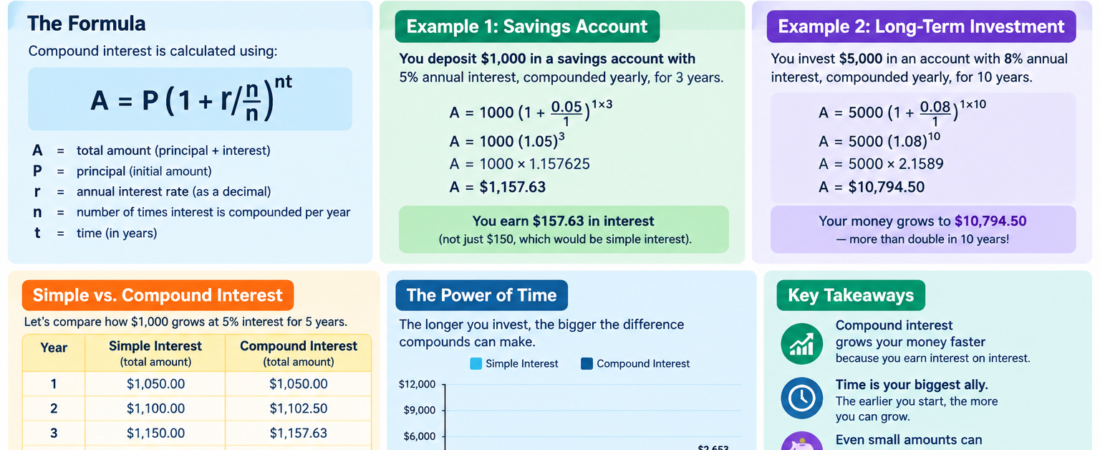
Suppose you deposit $1,000 into an account earning 5% annually, with interest compounded once per year.
After the first year:
$1,000 × 5% = $50
Your balance becomes:
$1,050
During the second year, the 5% interest is calculated on $1,050.
$1,050 × 5% = $52.50
Your new balance becomes:
$1,102.50
Notice what happened. In the second year, you earned $52.50 instead of $50 because your money had already grown.
After the third year, the balance would be approximately $1,157.63.
The additional $7.63 compared with simple interest is the beginning effect of compounding.
Why Time Matters
One of the most important features of compound interest is time.
The longer money remains in an account earning interest, the more opportunities there are for interest to build on previous interest.
For example, suppose two people each invest the same amount of money at the same rate. One starts much earlier and leaves the money invested for several additional years.
Even if both people contribute the same amount initially, the person who starts earlier may benefit from having more time for compounding to occur.
This is one reason starting to save early can be valuable.
Compound Interest With Regular Contributions
Compounding becomes even more powerful when you regularly add money to an account.
Imagine you start with $1,000 and then add $100 every month to a savings or investment account.
Now you’re not only earning returns on the original $1,000. As you make additional contributions, those amounts can also potentially earn returns.
Over many years, regular contributions can significantly increase the amount of money you accumulate.
The actual results will depend on the interest or investment return, contribution schedule, fees, taxes, and other factors.
How Compounding Frequency Works
Interest can be compounded at different frequencies.
Common examples include:
- Daily
- Monthly
- Quarterly
- Annually
Generally, when all other terms are the same, more frequent compounding can produce a slightly different result than annual compounding.
However, don’t choose a financial product based only on how frequently it compounds. The overall interest rate, fees, account terms, and other conditions also matter.
Example: Monthly Compounding
Suppose you have $1,000 in an account earning an annual rate of 6%, with interest compounded monthly.
The annual rate is divided into monthly periods, and interest is applied to the balance each month according to the account’s terms.
The first month’s interest is based on the applicable monthly rate and balance.
After that interest is added, the following month’s calculation can be based on the new balance.
Over time, these repeated calculations allow the account to grow through compounding.
Compound Interest on Savings
Compound interest can work in your favor when you’re saving money.
For example, if you keep money in an interest-bearing savings account, the bank may pay interest on your balance. When that interest is added to your account, future interest may be calculated on the larger balance.
This means you don’t necessarily have to contribute every dollar of growth yourself.
However, savings account interest rates can change, so the amount your money earns may vary over time.
Compound Interest on Investments
Compounding can also play an important role in long-term investing.
When investments generate returns and those returns remain invested, future growth can occur on the original investment as well as previous gains.
For example, suppose an investment grows from $10,000 to $11,000. If the additional $1,000 remains invested, future growth can apply to the larger amount.
Investment returns are not guaranteed, however. Unlike a savings account with a stated interest rate, investments such as stocks can rise and fall in value.
Compound Interest and Debt
Compounding isn’t always beneficial.
When you carry certain types of debt, interest can increase the amount you owe. Credit card balances are a common example.
Suppose you have a credit card balance and don’t pay it according to the card’s terms. Interest may be charged on the balance, increasing what you owe.
If you continue carrying the balance and making only small payments, the debt can become expensive.
This is why understanding compound interest is important for both saving money and managing debt.
The Rule of 72
The Rule of 72 is a simple estimation method often used to understand how long it might take money to double at a particular annual rate.
You divide 72 by the annual rate.
For example, at an estimated 6% annual return:
72 ÷ 6 = 12
So, under the simplified Rule of 72, it could take roughly 12 years for money to double.
This is only an estimate. Actual results depend on the rate, compounding method, taxes, fees, and whether the return remains constant.
How to Make Compound Interest Work for You
You can use the principles of compounding to improve your financial habits.
Start Early
The earlier you begin saving or investing, the more time your money has to potentially grow.
Contribute Regularly
Even small, consistent contributions can add up over many years.
Reinvest Your Earnings
When appropriate, leaving interest or investment returns invested allows future growth to occur on a larger balance.
Avoid High-Cost Debt
High-interest debt can work against you. Paying expensive debt down can help prevent interest from accumulating.
Compare Interest Rates and Fees
A higher rate can increase your earnings, while fees can reduce your overall growth. Consider both when comparing financial products.
A Long-Term Example
Imagine you save $5,000 and earn an average annual return of 5%, with the earnings remaining invested.
You don’t simply earn the same amount every year.
The first year’s growth is based on the original amount. Future growth can then be calculated on the larger balance.
Over many years, this difference can become increasingly noticeable.
This is why compound interest is sometimes described as a snowball: the balance can become larger, which creates the potential for larger amounts of growth in future periods.
Of course, real savings and investment results can vary, and investment returns are not guaranteed.
Final Thoughts
Compound interest is the process of earning interest or returns on both your original money and previously accumulated growth.
For savers and long-term investors, compounding can help money grow over time. For borrowers, interest can increase the cost of carrying debt.
The most important factors to remember are time, rate, consistency, and patience. Starting early, adding money regularly, and allowing earnings to remain invested can give compounding more opportunity to work.
At the same time, understanding how interest works can help you recognize why high-interest debt can become expensive and why paying balances down can be an important financial goal.
You don’t need to be a financial expert to understand compound interest. Once you see how a balance grows from one period to the next, the basic concept becomes much easier to understand and apply to everyday financial decisions.