
Saving money is one of the most important habits for building a stronger financial future. Whether you are saving for retirement, a home, education, or another major goal, putting money aside regularly can help you prepare for the future.
However, there is an important factor every long-term saver should understand: inflation.
Inflation can gradually reduce the purchasing power of your money. This means that the amount you save today may not buy the same amount of goods and services several years from now.
Understanding how inflation works can help you set realistic savings goals and make better decisions about where to keep your money.
What Is Inflation?
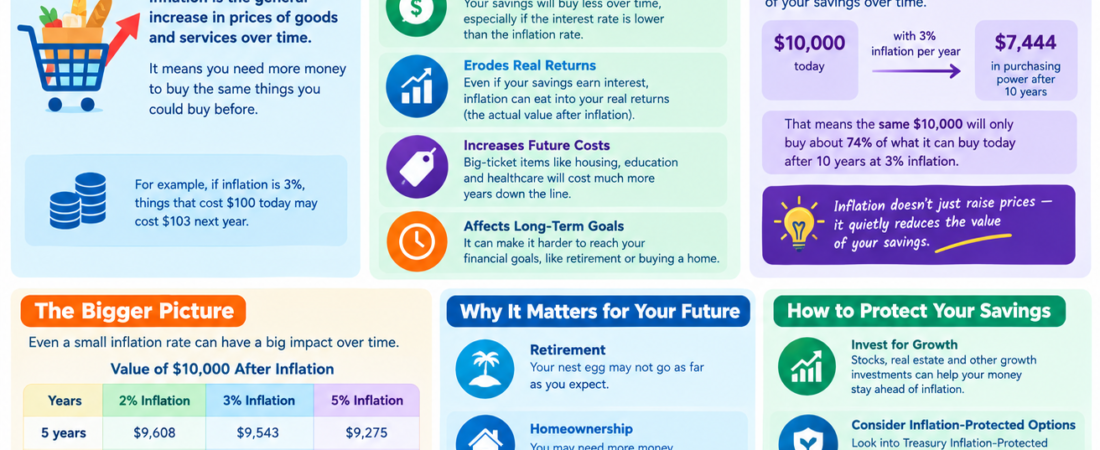
Inflation refers to a general increase in the prices of goods and services over time.
For example, imagine that a basket of everyday items costs $100 today. If prices increase by 3% over a year, the same basket could cost about $103. If prices continue rising, that same basket could cost considerably more several years later.
Inflation does not necessarily mean that every individual product becomes more expensive at the same rate. Some prices may rise quickly, while others may stay relatively stable or even fall. Inflation describes the overall movement of prices across an economy.
Why Inflation Matters for Your Savings
The biggest issue with inflation is that it reduces purchasing power.
Suppose you keep $10,000 in cash for many years. The number on your account may still show $10,000, but if prices have increased significantly during that time, that $10,000 may buy less than it could when you first saved it.
This is why simply looking at the amount of money you have saved is not enough.
You also need to think about what that money will be able to purchase in the future.
A Simple Example of Inflation
Imagine you want to save $50,000 for a future goal.
Today, $50,000 might be enough to cover the expenses you have in mind. But if the cost of those expenses increases over the next 10 or 20 years, you may need more than $50,000 to achieve the same goal.
For example, if the cost of something increases by an average of 3% per year, prices can rise substantially over a long period.
This does not mean inflation will always remain at 3%. Inflation changes over time. The example simply shows why long-term savers need to account for rising prices.
Inflation and Retirement Savings
Inflation is particularly important when planning for retirement.
Imagine you estimate that you need $30,000 per year to cover your expenses when you retire. If retirement is several decades away, the amount required to maintain a similar lifestyle could be much higher because prices may rise over time.
This is why retirement planning often involves estimating future expenses rather than simply using today’s costs.
If you are saving for retirement, consider how inflation could affect expenses such as:
- Housing
- Food
- Transportation
- Healthcare
- Utilities
- Insurance
- Leisure and travel
The goal is not to predict exactly what prices will be in the future. Instead, it is to recognize that future expenses may be higher than today’s expenses.
The Difference Between Saving and Growing Money
Saving money and growing money are related, but they are not exactly the same thing.
A savings account can provide a safe and accessible place to keep money and may pay interest. However, if the interest rate on your savings is lower than the inflation rate over a particular period, your money may lose purchasing power in real terms.
For example, suppose your savings earn 2% interest while inflation averages 4%. Your account balance is increasing, but prices are increasing faster.
This is sometimes described as having a negative real return.
A real return considers the effect of inflation on your investment or savings growth.
Why Interest Rates Matter
The interest rate you receive on savings can make a difference over time.
If you keep money in an account that pays little or no interest, inflation can gradually reduce its purchasing power.
On the other hand, a competitive savings rate may help offset some of inflation’s effects.
This is one reason it can be useful to compare savings accounts and review the interest rate you are receiving.
However, the highest interest rate should not automatically be your only consideration. You should also look at factors such as fees, accessibility, account requirements, and whether the account is appropriate for your financial goal.
Long-Term Savings May Need a Different Strategy
Not every dollar you own needs to be invested.
Money that you may need soon, such as an emergency fund or money for an upcoming expense, is generally more focused on safety and accessibility.
Long-term money may have a longer time horizon, which can allow you to consider investments with greater potential for growth. Investments can potentially provide returns that outpace inflation over long periods, but they also involve risk and can lose value.
The appropriate approach depends on your goal, time frame, financial situation, and ability to tolerate investment losses.
How to Protect Your Long-Term Savings From Inflation
There are several ways you can prepare for inflation.
1. Set Savings Goals Based on Future Costs
When planning for a goal that is many years away, avoid assuming today’s prices will remain unchanged.
Consider using a reasonable inflation assumption when estimating how much you may eventually need.
2. Increase Your Savings Over Time
As your income increases, consider increasing the amount you save.
For example, if you receive a salary increase, you could direct part of that additional income toward retirement or another long-term goal.
This can help your savings grow alongside your income and changing expenses.
3. Consider Long-Term Investments
For goals that are many years away, investing may provide an opportunity for your money to grow over time.
Diversified investments such as broad-market funds can be one option people consider for long-term goals. However, investments are not guaranteed and can decline in value.
Before investing, understand what you are buying and the risks involved.
4. Keep an Emergency Fund
Inflation can make unexpected expenses more expensive.
An emergency fund can help you handle unexpected bills without needing to sell long-term investments or rely heavily on expensive debt.
Keep emergency savings somewhere relatively safe and accessible.
5. Review Your Plan Regularly
Inflation rates, interest rates, income, expenses, and personal circumstances can all change.
Review your savings plan regularly to make sure your contributions still make sense.
If your original goal was based on an estimate from several years ago, you may need to update the target.
Inflation Does Not Mean You Should Stop Saving
Learning about inflation can sometimes make saving seem less useful, but that is not the right lesson.
Saving is still an important part of financial planning.
The key is understanding that different types of money can have different purposes.
You may keep some money readily available for emergencies and short-term expenses while using appropriate long-term savings or investment strategies for goals that are many years away.
The goal is to give each portion of your money a purpose.
Common Mistakes to Avoid
When planning long-term savings, try to avoid these common mistakes:
- Ignoring inflation completely
- Keeping all long-term money in cash without considering purchasing power
- Assuming a savings account will always beat inflation
- Taking excessive investment risk just to chase higher returns
- Forgetting to increase savings as income grows
- Using retirement savings for unnecessary short-term expenses
- Failing to review long-term goals
A balanced approach can help you prepare for both today’s needs and tomorrow’s expenses.
Final Thoughts
Inflation can have a significant effect on long-term savings because it reduces the purchasing power of money over time. A savings balance may increase in number while still losing purchasing power if prices rise faster than the return on your money.
The best response is not to panic about inflation but to understand it and include it in your financial planning.
Set realistic future savings targets, review the interest you earn on savings, increase contributions when possible, maintain an emergency fund, and consider appropriate long-term investments based on your goals and risk tolerance.
The earlier you understand inflation, the easier it becomes to build a financial plan designed not just to accumulate money, but to help that money retain its usefulness over the years.