
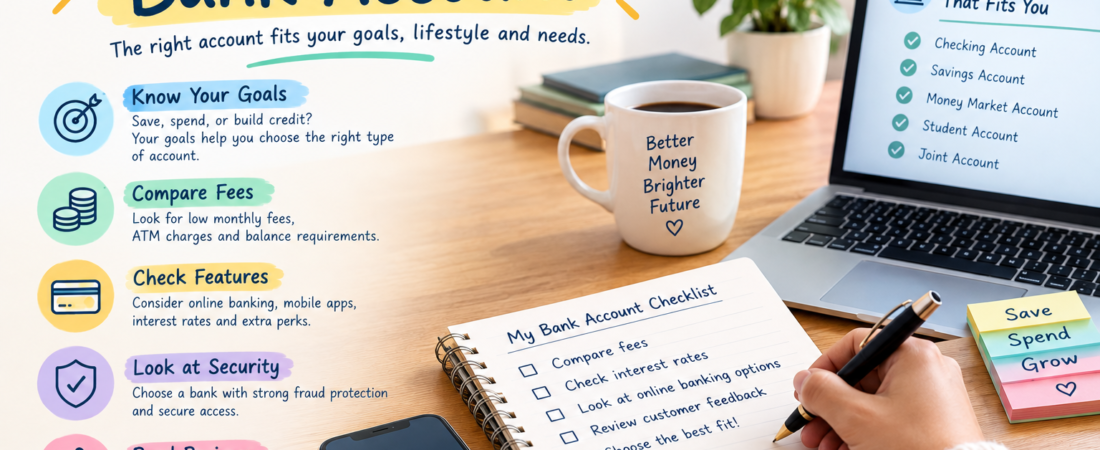
Choosing the right bank account is an important part of managing your personal finances. The account you choose can affect how easily you access your money, how much you pay in fees, and how much interest you earn on your savings.
With so many banks and account options available, it can sometimes feel difficult to know where to start. The good news is that choosing a bank account does not have to be complicated. By understanding your financial needs and comparing a few important features, you can find an account that fits your situation.
1. Determine Why You Need the Account
The first step is to decide what you want the account to do for you. Different bank accounts are designed for different purposes.
If you need an account for receiving your paycheck, paying bills, making purchases, and managing everyday expenses, a checking account may be appropriate.
If you want to set money aside for emergencies, future purchases, or financial goals, a savings account may be more suitable.
You may also decide to have both. Using a checking account for everyday expenses and a savings account for money you want to keep separate can make budgeting easier.
2. Compare Monthly Fees
Bank fees can gradually reduce the amount of money you have available. Before opening an account, check whether the bank charges a monthly maintenance fee.
Some banks waive monthly fees when you meet certain requirements, such as maintaining a minimum balance or receiving qualifying direct deposits. Other accounts may have no monthly fee at all.
Also look for other potential charges, including:
- ATM fees
- Overdraft fees
- Returned payment fees
- Wire transfer fees
- Excess transaction fees
- Paper statement fees
- Minimum balance fees
Understanding these costs before opening an account can help you avoid unpleasant surprises later.
3. Check the Interest Rate
If you are choosing a savings account, the interest rate is an important factor.
Interest allows your money to earn additional money over time. When comparing savings accounts, look at the annual percentage yield, or APY, because it reflects the effect of compounding.
A higher APY can make a difference, especially if you maintain a larger balance or plan to keep your money in the account for a long period.
However, do not choose an account based only on its interest rate. Consider fees, withdrawal rules, minimum balance requirements, and accessibility as well.
4. Consider How Easily You Can Access Your Money
Think about how frequently you will need to access your money.
If you need regular access, look for an account that offers convenient debit card access, ATMs, online banking, and mobile banking.
If the account is primarily for savings, you may not need as many everyday access features. However, you should still make sure you can access your money when necessary.
Convenience matters because an account that is difficult to use may make managing your finances more frustrating.
5. Look at ATM Availability
If you regularly use cash, ATM availability should be part of your decision.
Some banks have large ATM networks, while others may have fewer physical locations. Online banks may provide access to partner ATM networks or reimburse certain ATM fees depending on the account terms.
Before opening an account, find out where you can withdraw cash and whether you will have to pay fees for using ATMs outside the bank’s network.
6. Review Online and Mobile Banking Features
Modern banking is often done through a smartphone or computer. A good online banking system can make it easier to manage your money from almost anywhere.
Look for features such as:
- Mobile check deposit
- Account alerts
- Automatic transfers
- Bill payments
- Transaction notifications
- Digital statements
- Budgeting tools
- Card controls
- Easy account transfers
You should also consider whether the bank’s website and mobile app are easy for you to use.
7. Check Direct Deposit Options
If you receive a regular paycheck, direct deposit can make managing your money more convenient.
Your employer can deposit your income directly into your bank account instead of giving you a physical check.
Some banks may offer additional benefits for customers who receive qualifying direct deposits, such as reduced fees or other account features. Check the account terms to understand exactly what qualifies.
8. Understand Overdraft Policies
An overdraft can happen when you spend more money than is available in your checking account.
Banks have different policies for handling overdrafts. Some may decline a transaction, while others may allow the transaction and charge a fee. Some banks also offer optional overdraft protection or other services.
Before opening an account, understand how overdrafts are handled and what fees may apply.
A simple way to avoid overdrafts is to monitor your account balance regularly and keep a small buffer in your checking account.
9. Consider Minimum Balance Requirements
Some accounts require you to maintain a specific minimum balance.
For example, a bank may charge a fee if your balance falls below a certain amount. Other accounts may have no minimum balance requirement.
Think about how much money you normally keep in your account. If your balance changes significantly from month to month, an account without strict minimum balance requirements may be easier to manage.
10. Consider Bank Security and Insurance
When choosing a bank, security should be an important consideration.
If you are in the United States, check whether the bank is insured by the Federal Deposit Insurance Corporation, or FDIC. FDIC insurance generally protects eligible deposits up to applicable coverage limits if an insured bank fails.
Credit unions may instead have coverage through the National Credit Union Administration, or NCUA, for eligible deposits at federally insured credit unions.
You should also look for security features such as two-factor authentication, transaction alerts, fraud monitoring, and the ability to quickly lock a debit card.
11. Think About Customer Service
Good customer service can be valuable when you have a problem with your account.
Consider how you prefer to communicate with your financial institution. Some people prefer visiting a physical branch, while others are comfortable using phone support, online chat, or email.
If having a nearby branch is important to you, choose a bank with convenient locations. If you prefer digital banking, an online-focused bank may provide the features you need.
12. Compare Several Accounts
Avoid choosing the first account you find. Take some time to compare several options.
Create a simple comparison list that includes:
| Feature | Account A | Account B | Account C |
|---|---|---|---|
| Monthly fee | |||
| APY | |||
| Minimum balance | |||
| ATM access | |||
| Overdraft policy | |||
| Mobile banking | |||
| Direct deposit |
Writing down the differences can make your decision much easier.
13. Think About Your Future Needs
Your financial needs may change over time. An account that works well today may not be the best choice in the future.
Consider whether you may need additional services such as savings accounts, certificates of deposit, loans, credit cards, or investment services.
You do not necessarily need to use one financial institution for everything, but choosing an institution with services that fit your future needs can make financial management more convenient.
Final Thoughts
Choosing the right bank account starts with understanding your financial needs. Consider whether you need an account for everyday spending, saving, or both.
Compare important features such as monthly fees, interest rates, ATM access, minimum balances, overdraft policies, online banking, security, and customer service. Do not focus on just one feature. Look at the overall cost, convenience, and benefits of each account.
The right bank account should make managing your money easier rather than more complicated. By taking the time to compare your options and read the account terms carefully, you can choose an account that supports your financial habits and goals.