
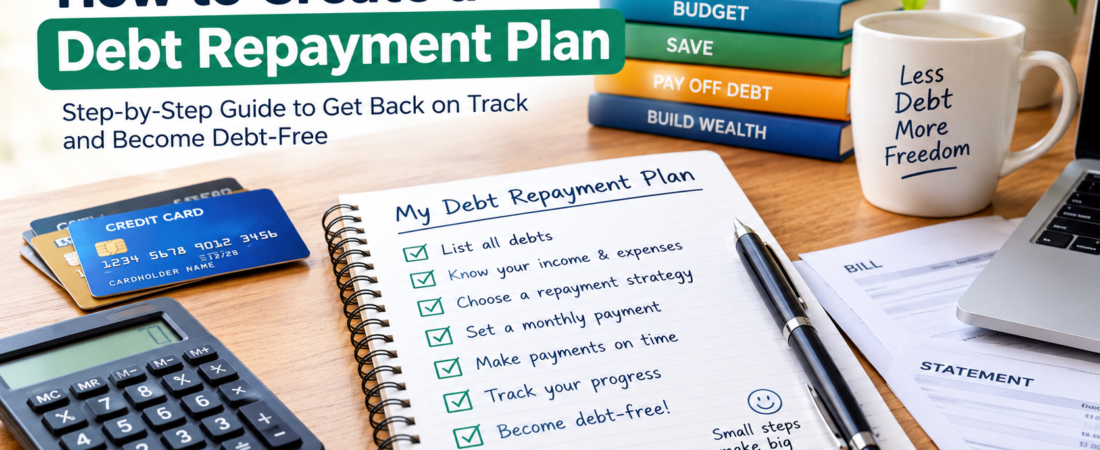
Debt can become stressful when you have several balances, different interest rates, and multiple payment dates to remember. The good news is that you don’t need to solve everything at once. A clear debt repayment plan can help you understand what you owe, organize your payments, and make steady progress toward becoming debt-free.
The key is to create a plan that fits your income and expenses. Once you know your numbers and choose a repayment strategy, managing your debt can become much easier.
1. List All of Your Debts
The first step is to understand exactly how much you owe.
Make a list of every debt you currently have, including:
- Credit card balances
- Personal loans
- Car loans
- Student loans
- Medical bills
- Buy-now-pay-later balances
- Other outstanding loans or bills
For each debt, write down the total balance, interest rate, minimum payment, and payment due date.
For example:
| Debt | Balance | Interest Rate | Minimum Payment |
|---|---|---|---|
| Credit Card A | $2,000 | 24% | $60 |
| Credit Card B | $1,200 | 19% | $40 |
| Personal Loan | $5,000 | 10% | $150 |
Having everything in one place gives you a clearer picture of your financial situation.
2. Calculate Your Monthly Income
Next, determine how much money you have available each month.
Use your regular take-home income rather than your gross salary. If your income changes from month to month, use a conservative estimate based on your typical earnings.
Include income from sources such as:
- Employment
- Freelancing
- Self-employment
- Benefits or support payments
- Other reliable income sources
Knowing your available income helps you create a repayment amount that you can realistically maintain.
3. Calculate Your Essential Expenses
Before deciding how much extra money to put toward debt, calculate your necessary monthly expenses.
These may include:
- Housing
- Utilities
- Groceries
- Transportation
- Insurance
- Childcare
- Essential medical expenses
- Minimum debt payments
Subtract these expenses from your monthly income.
For example:
Monthly income: $3,500
Essential expenses: $2,500
Money remaining: $1,000
You could then decide how much of that remaining amount should go toward additional debt payments while still leaving room for savings and unexpected expenses.
4. Keep Making Minimum Payments
Once you start your repayment plan, make sure you continue making at least the required minimum payment on every debt according to its terms.
Missing payments can lead to fees, additional interest, and potential damage to your credit history.
Your repayment strategy should generally focus your extra money on one debt while keeping the other accounts current.
Setting up automatic payments or reminders can make it easier to avoid missed due dates.
5. Choose a Debt Repayment Strategy
There are several ways to decide which debt to pay off first. Two commonly discussed approaches are the debt avalanche and debt snowball methods.
Debt Avalanche Method
With the debt avalanche method, you make the minimum payments on all debts and put extra money toward the debt with the highest interest rate.
Once that debt is paid off, you direct the money you were paying toward the next-highest-rate debt.
This approach can reduce the amount of interest paid over time, assuming other factors remain the same.
Debt Snowball Method
With the debt snowball method, you make minimum payments on all debts and put extra money toward the debt with the smallest balance.
Once the smallest debt is paid off, you move to the next-smallest balance.
Some people prefer this approach because paying off smaller balances can provide a sense of progress and simplify their list of debts.
Neither strategy has to be complicated. The important thing is to choose a method you can consistently follow.
6. Decide How Much Extra You Can Pay
After covering essential expenses and minimum debt payments, determine how much additional money you can put toward your repayment target.
For example, suppose you have $500 left after essential expenses and minimum payments.
You might decide to put an additional $350 toward your target debt while keeping $150 available for savings, irregular expenses, or other priorities.
Avoid creating a repayment plan that leaves you with no money for unexpected costs. A plan that is too aggressive may be difficult to maintain.
7. Build a Small Emergency Fund
Paying off debt is important, but having some emergency savings can also help.
Without any savings, an unexpected car repair, medical expense, or urgent bill could force you to borrow again.
If you don’t have an emergency fund, consider building a small cash reserve while working on your debt. Once your financial situation becomes more stable, you can work toward a larger emergency fund.
The right amount depends on your income, expenses, and circumstances.
8. Reduce Unnecessary Expenses
Finding ways to reduce spending can free up more money for debt repayment.
Look through your recent spending and identify expenses you can temporarily reduce or eliminate.
For example, you might:
- Cancel unused subscriptions
- Eat at home more often
- Reduce unnecessary shopping
- Compare insurance or service costs
- Limit impulse purchases
- Find less expensive entertainment options
You don’t have to eliminate every enjoyable activity. The goal is to create additional room in your budget without making your plan impossible to maintain.
9. Consider Increasing Your Income
Reducing expenses isn’t the only way to increase debt payments. You can also look for opportunities to increase your income.
Depending on your situation, possibilities might include:
- Working additional hours
- Freelancing
- Selling unused items
- Taking temporary work
- Offering services based on your skills
- Starting a small side business
You don’t necessarily need a large increase in income. Even an additional $100 or $200 per month can make a difference when consistently directed toward debt.
10. Avoid Adding New Debt
A repayment plan becomes much harder when new debt continues to accumulate.
While you’re paying down existing balances, try to avoid unnecessary borrowing. If you use a credit card, make sure you understand how the purchase will affect your repayment plan.
For example, paying $300 toward a credit card while adding $250 in new purchases doesn’t produce much progress.
Focus on reducing the balance rather than simply moving money around.
11. Track Your Progress
Tracking your debt can keep your plan organized and show you how far you’ve come.
You can use a spreadsheet, notebook, budgeting app, or simple list.
Record:
- Current balance
- Minimum payment
- Extra payment
- New balance
- Interest charged
- Date of payment
For example:
Starting balance: $3,000
Payment: $250
New balance: $2,750, before accounting for any interest or other transactions
Watching the balance decrease can make the process feel more manageable.
12. Adjust Your Plan When Your Situation Changes
Your debt repayment plan doesn’t have to remain exactly the same forever.
If your income increases, you may be able to make larger payments. If your expenses increase unexpectedly, you may need to temporarily reduce your extra payment.
Review your plan at least once a month.
Ask yourself:
- Is my repayment amount realistic?
- Have my expenses changed?
- Can I increase my payment?
- Am I keeping up with all minimum payments?
- Am I adding new debt?
- Do I need to adjust my budget?
Regular reviews can help keep your plan realistic.
Example of a Simple Debt Repayment Plan
Imagine you have three debts:
- Credit Card A: $2,500 at 25% interest
- Credit Card B: $1,000 at 18% interest
- Personal Loan: $4,000 at 9% interest
You could continue making the minimum payment on all three while directing additional money toward Credit Card A because it has the highest interest rate.
After paying it off, you could redirect that payment toward Credit Card B and then the personal loan.
As each balance disappears, the amount available for the next debt can increase.
Final Thoughts
Creating a debt repayment plan starts with understanding your financial situation. List your debts, calculate your income and expenses, continue making minimum payments, and choose a repayment strategy that works for you.
The debt avalanche method focuses on higher-interest debt first, while the debt snowball method focuses on smaller balances first. You can also combine these ideas with a realistic budget, emergency savings, and additional income.
Most importantly, don’t expect your debt to disappear overnight. Consistent payments and good financial habits can gradually reduce your balances.
The goal isn’t to create a perfect plan. It’s to create a plan you can realistically follow month after month. Every payment that reduces your debt brings you one step closer to greater financial flexibility and control.