
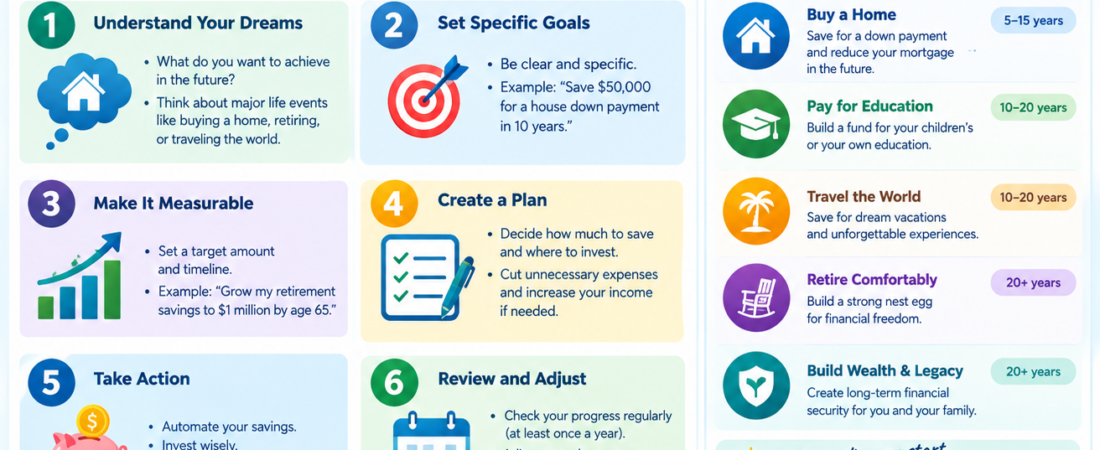
Having clear financial goals can make managing money much easier. Without goals, it is easy to spend whatever you earn without thinking about the future. Long-term financial goals give your money a purpose and help you make better decisions about saving, spending, investing, and debt.
A long-term financial goal is something you want to achieve with your money over several years. It could be buying a home, building retirement savings, paying off debt, starting a business, funding your children’s education, or simply becoming financially secure.
The good news is that you do not need to be wealthy to set meaningful financial goals. You just need a clear plan and the willingness to work toward it consistently.
1. Think About What You Want Your Future to Look Like
Before setting a financial goal, think about the life you want to build.
Ask yourself questions such as:
- Where do I want to live?
- Do I want to buy a home?
- When would I like to retire?
- Do I want to start a business?
- Do I want to travel regularly?
- Will I need money for education?
- What would financial security look like for me?
Your answers can help you identify the things that matter most. A financial goal should connect to something meaningful rather than simply being a random amount of money.
For example, instead of saying, “I want to save more money,” you might say, “I want to save enough for a home deposit within eight years.”
2. Make Your Goals Specific
A vague goal is difficult to measure. The more specific your goal is, the easier it becomes to create a plan.
Compare these two goals:
Vague: “I want to save for retirement.”
Specific: “I want to build a retirement fund that can support my expected expenses when I stop working.”
The second goal gives you something concrete to research and plan around.
Try to identify exactly what you want, how much it may cost, and when you want to achieve it.
3. Give Every Goal a Deadline
A deadline gives your goal direction.
For example, you might have goals such as:
- Buy a home in 10 years
- Pay off a student loan in five years
- Build a long-term investment portfolio over 15 years
- Save for your child’s education over 12 years
- Reach a specific retirement savings target by age 60
Your deadline should be realistic. If the time frame is too short, you may have to save an unrealistic amount each month. If it is too long, you may lose motivation.
4. Calculate How Much You Need
Once you know what you want and when you want it, estimate the amount of money required.
Suppose you want to save $30,000 for a future goal in five years. Ignoring investment growth, you would need to save about $500 per month:
$30,000 ÷ 60 months = $500 per month.
This simple calculation gives you a starting point.
For some goals, however, the future cost may be higher than today’s cost because prices can rise over time. This is particularly important for goals that are many years away, such as retirement, education, or buying property.
5. Break Big Goals Into Smaller Steps
Large financial goals can feel overwhelming when you look at the final number.
Instead of focusing only on the big target, break it into smaller milestones.
For example, if your goal is to save $20,000 in four years, you could divide it into yearly and monthly targets. This makes the goal easier to track and gives you regular opportunities to see your progress.
Small steps can eventually produce significant results.
6. Prioritize Your Goals
You may have several financial goals at the same time, but you do not necessarily need to work on all of them equally.
Start by identifying which goals are most important.
For example, you might prioritize:
- Building an emergency fund
- Paying off expensive debt
- Saving for a home
- Investing for retirement
- Saving for other long-term plans
Your priorities will depend on your personal circumstances.
The important thing is to avoid spreading your money so thinly that none of your goals receives enough attention.
7. Create a Monthly Plan
A long-term goal becomes much easier to achieve when it becomes part of your monthly budget.
Look at your income and regular expenses. Then determine how much you can reasonably put toward your long-term goals each month.
For example:
Monthly income: $3,000
Regular expenses: $2,300
Available amount: $700
You could decide to direct part of that remaining money toward savings or investments.
The exact amount will depend on your situation. The goal is to create a contribution that you can maintain consistently.
8. Automate Your Savings
One of the easiest ways to stay consistent is to automate your contributions.
You can arrange for money to move from your main account to a savings or investment account automatically after receiving your income.
Automation reduces the temptation to spend the money first.
For example, if you decide to save $300 every month, an automatic transfer can move that amount before you have a chance to use it for unnecessary spending.
Over several years, regular contributions can add up significantly.
9. Consider Inflation and Investment Growth
Long-term financial planning requires you to think beyond today’s prices.
Inflation means that the purchasing power of money can decrease over time. A certain amount of money may buy less in the future than it does today.
Investment returns can potentially help long-term savings grow, but investments also involve risk. Different investments have different levels of risk, potential returns, and time horizons.
For long-term goals, it can be useful to learn about options such as retirement accounts, diversified investments, and other appropriate savings vehicles.
Do your research and consider your risk tolerance before choosing investments.
10. Review Your Goals Regularly
Your financial situation can change over time.
You may get a new job, receive a raise, have new expenses, get married, have children, move to another location, or change your plans.
Because of this, your financial goals should not be treated as permanent.
Review them at least once or twice a year and ask:
- Am I still working toward the same goals?
- Am I saving enough?
- Have my expenses changed?
- Has my income changed?
- Do I need to adjust my deadline?
- Are my priorities different now?
Adjusting your plan does not mean you have failed. It means you are keeping your financial strategy realistic.
11. Avoid Comparing Your Goals With Other People
Everyone’s financial situation is different.
Someone else may buy a house at 30, retire at 50, or invest more money than you. That does not mean you are behind.
Your goals should be based on your income, responsibilities, values, and future plans.
Instead of comparing your progress with someone else’s, compare your current situation with where you were a year ago.
If your savings have increased, your debt has decreased, or your financial habits have improved, you are making progress.
12. Track Your Progress
Tracking your progress can keep you motivated.
You can use a spreadsheet, budgeting app, notebook, or simple document to record your goals.
For each goal, write down:
- The target amount
- Your deadline
- How much you have already saved
- How much you contribute regularly
- Your remaining amount
For example:
Goal: Home deposit
Target: $40,000
Current savings: $12,000
Remaining: $28,000
Deadline: Eight years
Seeing the numbers change over time can make a long-term goal feel much more achievable.
Common Mistakes to Avoid
When setting long-term financial goals, avoid making the process unnecessarily complicated.
Some common mistakes include:
- Setting unrealistic targets
- Forgetting about inflation
- Focusing on too many goals at once
- Ignoring high-interest debt
- Not keeping an emergency fund
- Failing to review your plan
- Investing without understanding the risks
- Giving up after missing a monthly target
Progress does not have to be perfect. Consistency is often more important than making large contributions occasionally.
Final Thoughts
Setting long-term financial goals gives your money a clear direction. Whether you want to buy a home, prepare for retirement, start a business, pay for education, or simply build financial security, the process starts with identifying what you want and creating a realistic plan.
Make your goals specific, give them deadlines, calculate what you need, and break large targets into smaller steps. Then make regular contributions and review your progress as your circumstances change.
You do not need to accomplish everything immediately. Long-term financial success is usually built through small decisions repeated consistently over many years.