
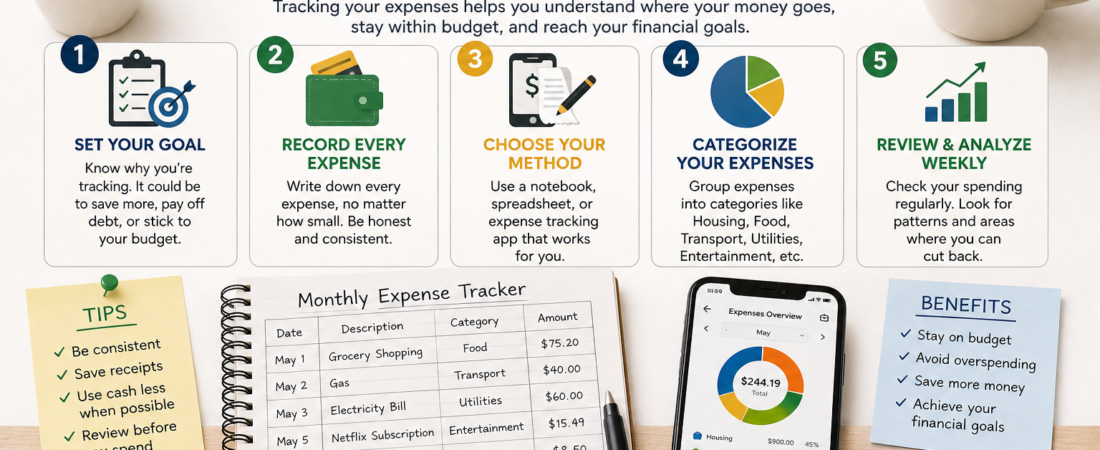
Knowing where your money goes each month is one of the most important steps toward better financial management. Many people know how much they earn but have a harder time identifying exactly where their money is being spent.
Tracking your monthly expenses gives you a clearer picture of your spending habits. It can help you find unnecessary expenses, stay within your budget, increase your savings, and make better financial decisions.
The good news is that you do not need complicated financial software to get started. A simple spreadsheet, notebook, budgeting app, or even your bank statements can be enough.
Here is a step-by-step guide to tracking your monthly expenses effectively.
1. Know Your Monthly Income
Before tracking expenses, determine how much money you have available each month.
Include your regular take-home income and any other reliable sources of money. If your income changes from month to month, use a realistic estimate rather than assuming you will always earn your highest amount.
Knowing your available income gives you a number to compare against your total spending.
2. Review Your Bank and Card Statements
Your bank and credit card statements are useful starting points because they provide a record of your transactions.
Go through recent statements and look at where your money has been going. Pay attention to recurring payments, small purchases, subscriptions, and fees that you may have forgotten about.
If you use multiple accounts or cards, review each one so you have a complete picture of your spending.
3. Create Expense Categories
Organizing expenses into categories makes your spending easier to understand.
Common categories include:
- Housing
- Groceries
- Transportation
- Utilities
- Insurance
- Healthcare
- Debt payments
- Entertainment
- Shopping
- Dining out
- Subscriptions
- Savings
You do not need dozens of categories. Start with broad groups and add more detail only when it is useful.
4. Record Every Purchase
Small purchases can be easy to forget, especially when they happen frequently.
A coffee, snack, delivery fee, mobile purchase, or small online order may not seem significant individually. However, several small purchases can add up over the course of a month.
Record purchases as soon as possible. You can use your phone, a spreadsheet, a budgeting app, or a notebook.
The more complete your records are, the more useful your spending analysis will be.
5. Choose a Tracking Method
There are several ways to track expenses, so choose the method you are most likely to use consistently.
Spreadsheet
A spreadsheet allows you to create categories, enter transactions, and calculate totals.
It is a good option if you like having control over your financial information and want to customize your system.
Budgeting App
A budgeting app can make expense tracking more convenient by organizing transactions and providing summaries.
Before using any financial app, understand its privacy, security, and account-access features.
Notebook
A simple notebook can work perfectly well. Write down each expense and organize it by category.
The best system is not necessarily the most advanced one. It is the one you will actually use.
6. Separate Fixed and Variable Expenses
It can be helpful to divide your expenses into fixed and variable costs.
Fixed expenses generally remain similar each month. Examples include rent, loan payments, insurance, or certain subscriptions.
Variable expenses can change from month to month. Examples include groceries, entertainment, transportation, and shopping.
Understanding the difference helps you identify which expenses are easier to adjust when you need to reduce spending.
7. Track Recurring Subscriptions
Subscriptions can be easy to overlook because payments may happen automatically.
Review your recurring charges and make a list of services you pay for each month or year.
Ask yourself whether you still use each service. Canceling subscriptions you no longer need can free up money for other priorities.
Also remember to check for annual subscriptions, since they may not appear as monthly expenses.
8. Track Cash Spending
If you use cash, make sure those purchases are included in your records.
Cash transactions can easily disappear from your spending history because they may not appear in a bank or credit card statement.
Keep receipts when possible or record cash purchases immediately.
Even a simple note on your phone can help you remember what you spent.
9. Review Your Spending Weekly
You do not have to wait until the end of the month to check your expenses.
Set aside a few minutes each week to review your transactions.
Check whether you are spending more than expected in any category. If you notice a problem early, you still have time to adjust your spending before the month ends.
A weekly review can also make the end-of-month financial review much easier.
10. Compare Spending With Your Budget
Expense tracking and budgeting work best together.
If you have a monthly budget, compare your actual spending with the amount you planned to spend.
For example, if you budgeted $400 for groceries but have already spent $350 halfway through the month, you know you may need to be more careful with grocery spending for the rest of the month.
This information allows you to make adjustments before overspending becomes a larger problem.
11. Look for Spending Patterns
After tracking your expenses for a few months, look for patterns.
You may notice that you spend more on weekends, order food frequently, make frequent online purchases, or pay for services you rarely use.
The purpose is not to criticize yourself. Instead, use the information to understand your habits.
Once you know where your money is going, you can decide which changes are worthwhile.
12. Identify Unnecessary Expenses
Not every expense needs to be eliminated. However, tracking can help you identify purchases that provide little value.
Look for expenses that you rarely use or purchases you make out of habit rather than genuine need.
For example, you might discover that several small subscriptions, frequent delivery charges, or impulse purchases are taking up a significant part of your monthly budget.
13. Plan for Irregular Expenses
Some expenses do not occur every month, but they still need to be included in your financial planning.
Examples include:
- Car repairs
- Annual insurance
- Holiday spending
- School expenses
- Property maintenance
- Medical expenses
- Gifts
Instead of being surprised by these costs, estimate them and set aside money regularly when possible.
14. Review Your Expenses at the End of the Month
At the end of each month, calculate your total spending in each category.
Ask yourself:
- Did I stay within my budget?
- Which category cost the most?
- Where did I overspend?
- Were there unexpected expenses?
- Did I save the amount I planned to save?
- Which expenses can I reduce next month?
This monthly review turns your expense records into useful information.
15. Make Small Changes
You do not need to completely change your lifestyle after reviewing your expenses.
Instead, focus on a few realistic improvements.
You might reduce restaurant meals, cancel an unused subscription, set a shopping limit, or reduce unnecessary transportation costs.
Small changes can become significant when maintained consistently over time.
Keep the Process Simple
One of the biggest reasons people stop tracking expenses is that their system becomes too complicated.
You do not need to record every detail if doing so makes the process frustrating. Choose a method that is simple enough to maintain.
You could spend 10 minutes each evening recording purchases or 20–30 minutes once or twice a week reviewing transactions.
Consistency is more important than complexity.
Conclusion
Tracking your monthly expenses gives you a clear understanding of how you use your money. By reviewing your income, recording purchases, organizing expenses into categories, monitoring subscriptions, and reviewing your spending regularly, you can identify patterns and make more informed financial decisions.
Start with a simple tracking system and use it consistently. After a few months, you should have a much clearer picture of your spending habits and be in a better position to create a budget that reflects your real financial life.