
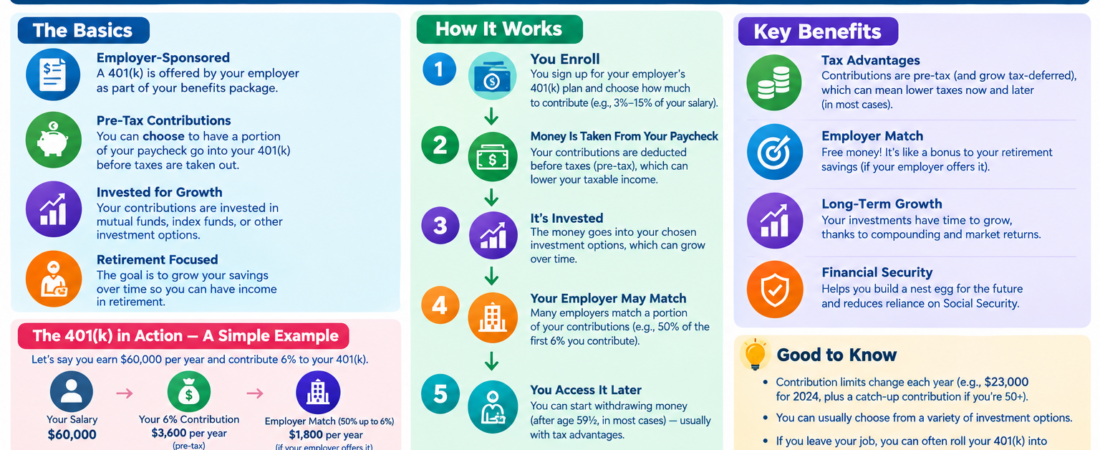
Planning for retirement can seem complicated when you’re just getting started. One of the most common retirement savings options in the United States is a 401(k) plan. If your employer offers one, understanding how it works can help you make more informed decisions about saving for your future.
A 401(k) is an employer-sponsored retirement savings plan that allows eligible employees to contribute money from their paychecks toward retirement. Depending on the plan, an employer may also contribute money on behalf of employees.
The money in a 401(k) can generally be invested in options offered by the plan, allowing your retirement savings to potentially grow over many years.
What Is a 401(k)?
A 401(k) is a type of workplace retirement plan named after a section of the U.S. tax code.
Employees can contribute part of their earnings to the plan, subject to applicable annual limits. The money can then be invested in funds or other investment options provided by the employer’s plan.
One of the main advantages of a 401(k) is that contributions can often be made automatically through payroll deductions.
Instead of receiving your entire paycheck and then remembering to save money separately, you can direct a portion of your pay into your retirement account before or after taxes, depending on the type of 401(k) contribution.
How Does a 401(k) Work?
Suppose you earn $4,000 per month and decide to contribute 5% of your eligible pay to your 401(k).
Your contribution would be:
$4,000 × 5% = $200
That $200 would be directed into your retirement account according to your employer’s payroll schedule and plan rules.
You can then choose from the investment options available through your plan.
Over time, your contributions and any investment earnings can accumulate.
The value of your account can increase or decrease depending on investment performance, contributions, fees, and withdrawals.
Traditional 401(k)
A traditional 401(k) generally allows eligible employees to make contributions on a pre-tax basis.
This means contributions can generally reduce your taxable income for the year in which they are made, subject to applicable tax rules.
For example, if you earn $60,000 and contribute $5,000 to a traditional 401(k), your federal taxable income may be reduced by that contribution, depending on your circumstances.
However, you generally pay income taxes when you withdraw money from the account in retirement.
The exact tax treatment depends on applicable tax laws and your individual situation.
Roth 401(k)
Some employers offer a Roth 401(k) option.
With a Roth 401(k), contributions are generally made with after-tax dollars. You don’t generally receive the same upfront federal income-tax deduction that traditional 401(k) contributions may provide.
However, qualified withdrawals from a Roth 401(k) can generally be tax-free under applicable rules.
The main difference is when you receive the tax benefit:
Traditional 401(k): Potential tax benefit when contributing, taxes generally paid on taxable withdrawals later.
Roth 401(k): Taxes generally paid before contributing, with qualified withdrawals potentially tax-free.
Which option is more appropriate depends on your circumstances, tax situation, and retirement goals.
What Is an Employer Match?
One of the most valuable features of some 401(k) plans is an employer matching contribution.
An employer match means your employer contributes money to your retirement account based on your own contributions, according to the plan’s rules.
For example, suppose an employer offers a 50% match on employee contributions up to 6% of eligible pay.
If you contribute 6%, the employer could contribute an additional amount equal to 3% of your eligible pay.
The exact matching formula varies from employer to employer.
If your workplace offers a match, understand the requirements carefully, including any vesting rules.
What Is Vesting?
Vesting determines how much of certain employer contributions you are entitled to keep if you leave your job.
Your own contributions are generally yours, but employer contributions may be subject to a vesting schedule.
For example, a plan might provide immediate vesting or require you to work for a certain period before all employer contributions become fully yours.
Check your specific plan documents to understand the rules.
How Are 401(k) Contributions Invested?
Money in a 401(k) generally isn’t simply left as cash. Participants usually choose from investment options provided by the plan.
These options may include:
- Stock funds
- Bond funds
- Target-date funds
- Money market or stable-value options
- Other investment choices
The available options depend on the employer’s plan.
A target-date fund, for example, is designed around an expected retirement year and typically changes its investment mix over time.
Before choosing investments, understand the risks, fees, and objectives of each option.
Why Start Saving Early?
Time can be an important factor in retirement savings.
When money remains invested for many years, investment earnings can potentially generate additional earnings. This is related to the concept of compound growth.
For example, if you contribute regularly throughout your working years, your account can potentially grow through a combination of new contributions and investment returns.
Investment returns are not guaranteed, however. The value of investments can rise and fall.
Starting earlier can also give you more time to adjust your contributions as your income and circumstances change.
What Happens If You Change Jobs?
If you leave your employer, you generally have several options for your 401(k), depending on the plan and applicable rules.
You may be able to:
- Leave the money in your former employer’s plan
- Roll it into an eligible individual retirement account
- Roll it into a new employer’s eligible retirement plan
- Take a distribution, subject to applicable tax rules and potential penalties
A direct rollover can help you avoid having the money treated as a taxable distribution when the rollover requirements are met.
Before moving retirement funds, understand the tax consequences, fees, investment options, and rules associated with each option.
Can You Withdraw Money From a 401(k)?
A 401(k) is designed primarily for retirement, so withdrawals before the applicable retirement age can have tax consequences and may be subject to an additional tax unless an exception applies.
Some plans may also allow loans or certain hardship distributions, but these options have specific rules and potential disadvantages.
For example, taking money out of a retirement account early can reduce the amount available for future growth.
Before making an early withdrawal, understand the applicable tax rules and your plan’s requirements.
401(k) Loans
Some 401(k) plans allow participants to borrow from their accounts.
A 401(k) loan is different from an ordinary withdrawal because the borrowed amount is generally repaid to the account under the plan’s rules.
However, 401(k) loans have risks. If you leave your employer, the outstanding loan may become due under the applicable terms. Failure to repay can result in the amount being treated as a distribution, potentially creating taxes and additional penalties.
Not every plan offers loans.
How Much Should You Contribute?
There isn’t one contribution percentage that works for everyone.
Your appropriate savings rate depends on factors such as:
- Your income
- Age
- Retirement goals
- Employer match
- Current expenses
- Debt
- Other retirement accounts
- Expected retirement timeline
If you’re just beginning, starting with an amount you can consistently afford may be better than waiting until you can contribute a large percentage.
You can then increase your contributions as your income grows.
Common 401(k) Mistakes to Avoid
One common mistake is failing to understand your employer’s matching policy.
Another is ignoring investment fees. Even small differences in fees can affect long-term results.
Some people also make the mistake of investing without understanding what their plan options actually contain.
Finally, avoid treating your 401(k) like a regular savings account. Retirement accounts are designed for long-term purposes and may have tax consequences for certain withdrawals.
Final Thoughts
A 401(k) is a workplace retirement savings plan that allows eligible employees to contribute part of their income toward retirement. Depending on the plan, contributions may be made through traditional pre-tax contributions, Roth contributions, or both.
Employer matching contributions can provide another source of retirement savings, while the investment options available through the plan give your money an opportunity to grow over time.
The rules surrounding contributions, withdrawals, taxes, employer matching, vesting, and investment choices can vary. That’s why it’s important to review your specific plan documents and understand how your employer’s plan works.
For someone beginning retirement planning, learning how a 401(k) works is an important first step toward understanding workplace retirement savings and building a long-term financial strategy.