
Investing can seem complicated when you first start learning about stocks, bonds, mutual funds, and other financial products. One term you may come across frequently is index fund.
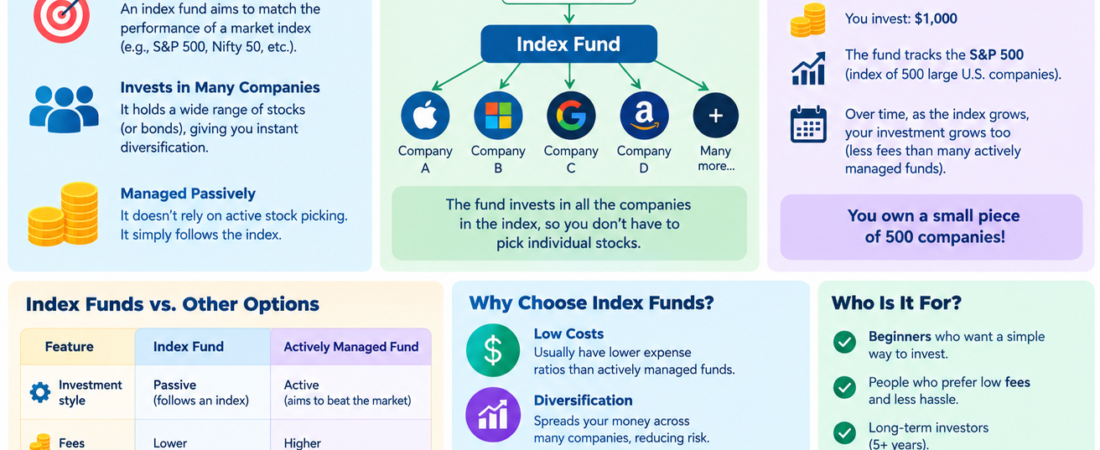
An index fund is an investment fund designed to follow the performance of a particular market index. Instead of trying to choose individual investments that will outperform the market, an index fund generally aims to track a specific group of investments.
Index funds have become popular with many investors because they can provide diversification, relatively simple portfolio management, and potentially lower costs than some actively managed funds.
However, like all investments, index funds involve risks, and their value can go up or down.
What Is an Index?
Before understanding an index fund, it helps to understand what a market index is.
A market index is a collection or measurement of investments designed to represent a particular section of the financial market.
For example, an index might track:
- Large companies in a particular country
- Technology companies
- Companies from a particular industry
- International stocks
- Government bonds
- Small companies
One well-known example is the S&P 500, which tracks large U.S. companies.
An index isn’t something you normally buy directly. Instead, an investment fund can be designed to follow the index.
What Is an Index Fund?
An index fund is a mutual fund or exchange-traded fund (ETF) designed to track a specific index.
For example, an index fund that follows the S&P 500 seeks to provide investment performance that generally corresponds to that index, before fees and expenses.
Rather than having a manager constantly select individual companies based on predictions about which ones will perform best, the fund generally follows the rules of the index it tracks.
This is known as passive investing.
How Does an Index Fund Work?
Imagine an index contains 500 large companies.
An index fund designed to track that index may hold shares of many or all of those companies in proportions intended to reflect the index.
If the index rises, the value of the fund will generally rise as well, although the fund’s actual performance may differ because of fees, expenses, tracking differences, and other factors.
If the index falls, the fund’s value can also decline.
The goal isn’t usually to beat the index. The goal is to track it.
Index Funds vs. Actively Managed Funds
One major difference between index funds and actively managed funds is how investments are selected.
Index Funds
Index funds generally follow a predetermined index.
Their managers typically don’t make frequent decisions about which individual investments to buy or sell based on predictions about future market performance.
Actively Managed Funds
Actively managed funds generally have managers who select investments based on their research, analysis, and investment strategy.
The manager may attempt to outperform a particular benchmark.
Neither approach guarantees a particular investment result. Both types of funds can lose money.
Why Do People Invest in Index Funds?
One reason investors consider index funds is diversification.
Instead of buying shares in only one company, an index fund may give an investor exposure to many different companies or other investments through a single fund.
For example, buying one fund that tracks a broad stock index can provide exposure to many companies across different industries.
Diversification can reduce the impact that one individual investment has on a portfolio, although it cannot eliminate investment risk.
Lower Costs
Another potential advantage of index funds is their cost.
Because index funds generally follow an existing index rather than relying on frequent active investment decisions, some index funds have relatively low expense ratios.
An expense ratio is an annual operating expense charged by a fund, expressed as a percentage of assets.
For example, a fund with a 0.10% expense ratio would charge approximately $1 per year for every $1,000 invested, before considering changes in the investment’s value.
Small differences in fees can matter over long periods, particularly when large amounts of money are invested.
However, fees vary, so investors should check the specific fund’s expense ratio and other costs.
What Is an ETF?
An ETF, or exchange-traded fund, is an investment fund that trades on a stock exchange.
Many index funds are ETFs, although not all ETFs are index funds.
An ETF can hold a collection of stocks, bonds, or other investments. Investors can generally buy and sell ETF shares during market hours through a brokerage account.
Some index funds are also structured as mutual funds rather than ETFs.
What Is a Mutual Fund?
A mutual fund pools money from many investors and uses that money to purchase a collection of investments.
An index mutual fund is designed to track a particular index.
Unlike ETFs, mutual funds generally aren’t traded continuously throughout the trading day. Their transactions are typically processed based on the fund’s net asset value under the applicable rules.
Both index mutual funds and index ETFs can provide diversified exposure to a particular market.
Examples of Different Types of Index Funds
Index funds can follow many different types of indexes.
Broad Market Index Funds
These funds aim to track a broad section of the stock market.
They can provide exposure to companies across multiple industries.
Large-Cap Index Funds
These funds focus on larger companies, depending on the index they track.
International Index Funds
These funds may provide exposure to companies outside the investor’s home country.
Bond Index Funds
Instead of tracking stocks, these funds track indexes made up of bonds.
Sector Index Funds
These funds focus on a specific industry or sector, such as technology, healthcare, or energy.
Because sector funds are more concentrated, they may carry different risks from broad-market funds.
Are Index Funds Safe?
Index funds are investments, so they are not risk-free.
The value of an index fund can decline when the investments it holds decline in value.
For example, a stock index fund could lose value during a broad market downturn.
The level of risk depends on what the fund tracks. A broad stock-market index fund has different risks from a bond index fund or a narrowly focused sector fund.
Before investing, consider your time horizon, financial goals, risk tolerance, and overall financial situation.
How to Choose an Index Fund
If you’re considering an index fund, look at several factors.
1. The Index It Tracks
Understand what the fund actually invests in.
A broad-market index and a technology-sector index can behave very differently.
2. Expense Ratio
Compare the fund’s annual operating expenses with similar funds.
3. Tracking Difference
Check how closely the fund has historically followed its underlying index.
4. Diversification
Look at how many investments the fund holds and how concentrated the portfolio is.
5. Fund Structure
Determine whether you’re considering an ETF or mutual fund and understand how each works.
6. Your Investment Goals
Make sure the fund fits your overall investment plan rather than choosing it simply because it has performed well recently.
Index Funds and Long-Term Investing
Index funds are often associated with long-term investing because they can provide broad market exposure without requiring investors to select individual stocks.
For example, someone saving for a long-term goal may choose a diversified investment portfolio containing index funds.
However, your investment choices should reflect your own goals and circumstances. Money needed in the near future may not be appropriate for investments that can fluctuate significantly in value.
Common Mistakes Beginners Should Avoid
New investors can make several mistakes when using index funds.
One is assuming that an index fund cannot lose money. It can.
Another is choosing a fund without understanding what index it tracks.
Some investors also focus too much on recent performance. Past performance does not guarantee future results.
Finally, don’t ignore fees. Even relatively small annual expenses can affect long-term returns.
Final Thoughts
An index fund is an investment fund designed to track a particular market index. Instead of trying to select individual investments that will outperform the market, the fund generally follows the investments and weighting rules of its chosen index.
Index funds can offer diversification, relatively simple investing, and potentially low costs. They are available in different forms, including ETFs and mutual funds, and can focus on stocks, bonds, international markets, broad markets, or specific sectors.
However, index funds are still investments and can lose value. Before investing, understand what the fund tracks, how much it costs, how diversified it is, and whether it fits your financial goals and time horizon.
For beginners, learning how index funds work is a useful step toward understanding the broader world of investing and building a more informed long-term financial plan.