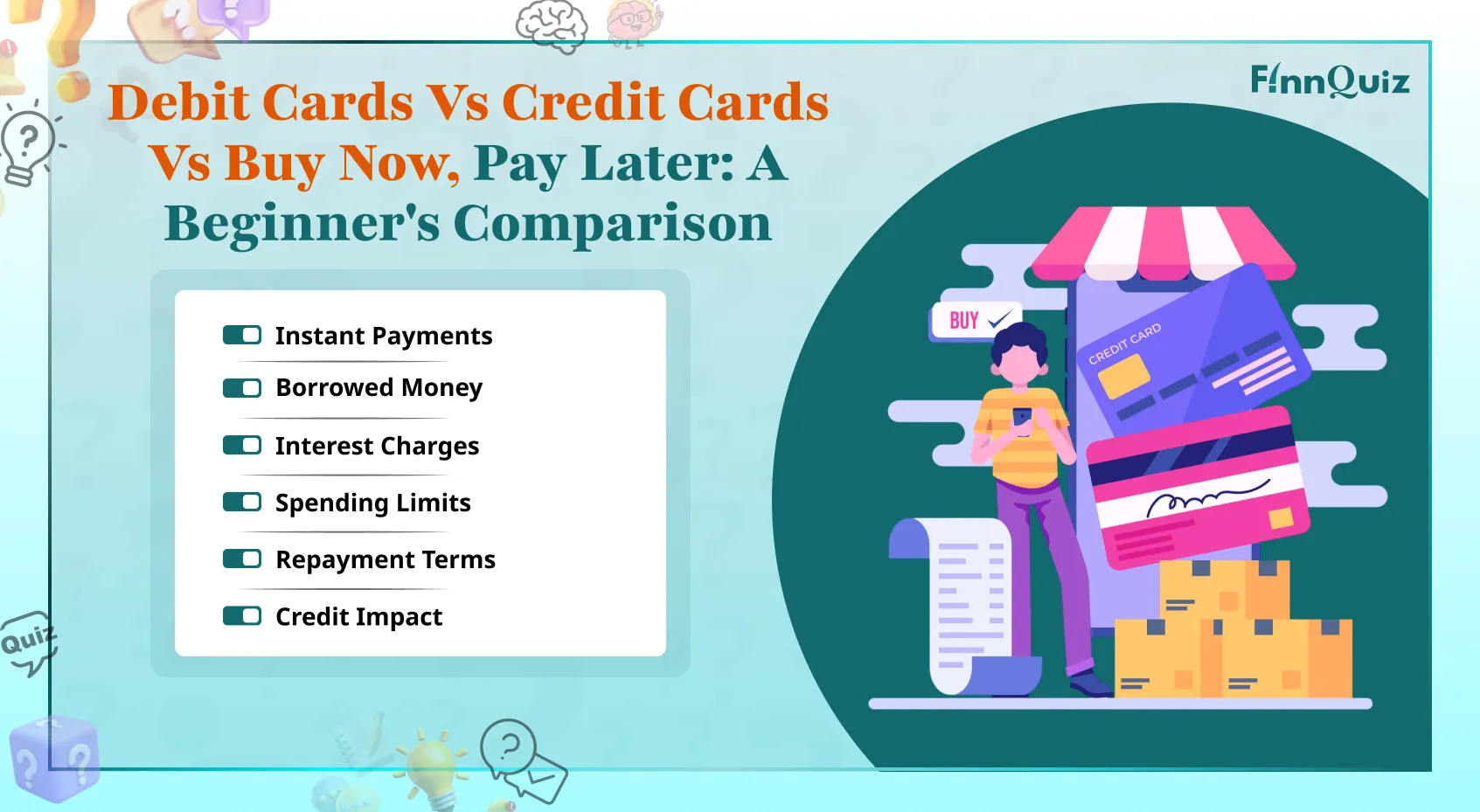
Debit cards take money straight from your bank account. Credit cards let you borrow money and pay it back later, usually with interest if you carry a balance. Buy now, pay later (BNPL) splits a purchase into a few installments, often with no interest, but can charge steep late fees and may now affect your credit. The right choice depends on what you are buying, whether you can pay on time, and how much risk you are willing to take. This guide compares all three side by side so you can pick the smartest option for every purchase.
The Contract Behind Each Payment Method
- Debit card: A payment card linked to your checking account. You can only spend what you have. No borrowing, no interest, and no credit reporting.
- Credit card: A revolving line of credit. You borrow money to make purchases and must repay it, usually with interest if you carry a balance. Payment history is reported to credit bureaus.
- Buy now, pay later (BNPL): A short-term installment loan offered at checkout. You split a purchase into equal payments, often interest-free, but late fees apply if you miss a payment. Some providers now report to credit bureaus.
- APR (Annual Percentage Rate): The yearly interest rate charged on credit card balances. Rates typically range from 15% to 28% for most cards.
- Grace period: The time between your statement closing date and your payment due date (usually 21–25 days) during which you can pay your balance in full and avoid interest.
- Credit utilization: The ratio of your credit card balance to your credit limit. It accounts for 30% of your FICO score. Keeping it below 30% is recommended.
- Fair Credit Billing Act (FCBA): A federal law that limits your liability for unauthorized credit card charges to $50 and provides a process for disputing billing errors.
- Electronic Fund Transfer Act (EFTA): A federal law that limits your liability for unauthorized debit card transactions, but with stricter time limits and potentially higher liability than credit cards.
How Each Payment Method Works
Debit cards are connected directly to your checking account. When you swipe, tap, or enter your card online, the money is deducted almost immediately. You are spending your own money. There is no interest, no credit check, and no reporting to credit bureaus. Your spending limit is your available balance, plus any overdraft protection you may have.
Credit cards are a form of revolving credit. The card issuer pays the merchant on your behalf, and you receive a monthly statement with a balance to repay. If you pay the full balance by the due date, you avoid interest. If you pay less, interest accrues on the remaining balance. Credit card usage is reported to credit bureaus and directly affects your credit score. You also get robust fraud protection under the Fair Credit Billing Act.
Buy now, pay later is a type of installment loan offered at checkout by providers like Klarna, Afterpay, and Affirm. You typically split the purchase into four equal payments over six weeks, or into monthly payments for larger items. Most BNPL plans are advertised as interest-free, but they often charge late fees if you miss a payment. Some BNPL providers report payment history to credit bureaus, meaning missed payments can damage your credit while on-time payments may help build it, depending on the bureau.
Detailed Purchase Example: Buying a $500 Laptop
Imagine you need to buy a $500 laptop. Here is how each method would work.
Debit card: You pay $500 immediately. The money is deducted from your checking account. You have no debt, no interest, and no credit impact. However, if the laptop is defective or never arrives, your ability to dispute the charge is limited, and your bank account is temporarily $500 lighter while the dispute is investigated.
Credit card: You charge $500 to your credit card. You receive a statement at the end of the month. If you pay the full $500 by the due date, you pay no interest. You earn rewards (e.g., 2% cashback = $10 back). You also get strong fraud protection and the ability to dispute the charge under the Fair Credit Billing Act. The purchase helps build your credit history. If you only pay the minimum, interest accrues at, say, 20% APR, costing about $8 per month on the remaining balance.
BNPL: You select BNPL at checkout. You pay $125 today, and then $125 every two weeks for the next six weeks (total $500, assuming no fees). You pay no interest if you make all payments on time. However, if you miss a payment, you may incur a late fee (e.g., $8–$15 per missed installment). The BNPL provider may also report the missed payment to credit bureaus, lowering your credit score. If you return the laptop, the refund process can be slower because the BNPL provider must cancel future payments, which may take several days.
Comparison Table: Debit vs Credit vs BNPL
| Feature | Debit Card | Credit Card | Buy Now, Pay Later |
|---|---|---|---|
| Source of funds | Your own money | Borrowed from the issuer | Short-term loan from provider |
| Interest charges | None | 15–28% APR if balance carried | Usually 0% if paid on time |
| Late fees | Overdraft fees if insufficient funds | $25–$40 late payment fee | $5–$40 per missed installment |
| Credit reporting | No | Yes (payment history, utilization) | Increasingly yes (for missed and sometimes on-time payments) |
| Fraud protection | Limited (EFTA, $50–$500+ depending on timing) | Strong (FCBA, max $50, often $0 liability) | Varies by provider, generally weaker than credit cards |
| Dispute rights | Limited and time-sensitive | Strong protections under FCBA | Varies, often less robust than credit cards |
| Refunds | Money returned to checking account | Credit to card account | Future installments canceled, refund may take several days |
| Overspending risk | Low (limited to available balance) | High (credit limit can tempt overspending) | Medium (small installments can hide total cost) |
| Late-payment consequences | Overdraft fees, possible account closure | Late fee, penalty APR, credit damage | Late fee, potential credit damage, collection activity |
| Best for | Everyday spending, ATM withdrawals | Large purchases, online shopping, building credit, earning rewards | Planned, budgeted purchases you could pay cash for, to manage cash flow |
Common Mistakes to Avoid
- Using a debit card for large or online purchases: You get weaker fraud protection and your bank account can be drained during disputes.
- Carrying a credit card balance: Paying interest negates any rewards and can cost hundreds per year. Always pay the full statement balance.
- Making only the minimum payment on a credit card: This keeps you in debt for years and costs thousands in interest.
- Stacking multiple BNPL plans: Small payments of $25–$50 each can add up to a large monthly obligation that strains your budget.
- Treating BNPL as 'free money': BNPL does not make the purchase cheaper; it just delays payment. Late fees and credit damage are real risks.
- Closing old credit cards: This shortens your credit history and increases your credit utilization ratio, both of which can lower your score.
- Ignoring credit card statements: Errors, fraudulent charges, and fee changes can go unnoticed. Review every statement.
Important Exceptions and Limitations
Not everyone qualifies for a credit card or BNPL. If you have no credit history, you may need a secured credit card (which requires a cash deposit) to start building credit. Some BNPL providers also perform soft credit checks, but may still approve users with limited credit.
Debit cards may have daily spending limits, which can be a problem for large purchases. Also, some debit cards offer cashback or rewards, but these are rare compared to credit cards.
For BNPL, not all retailers offer the same terms. Some charge interest for longer payment plans (e.g., 6–12 months). Always read the specific terms before selecting BNPL.
If you are carrying high-interest credit card debt, you should focus on paying it down before using BNPL. BNPL can add to your debt load and make it harder to get out of the cycle.
Practical Decision Checklist
- Is this purchase essential or discretionary? Essential buys are safer with any method, but discretionary buys should be carefully considered.
- Can I pay the full amount upfront without hardship? If yes, consider a debit card or credit card paid in full.
- Do I want to build credit? If yes, use a credit card and pay the full balance on time.
- Do I need fraud protection? For online or large purchases, a credit card is the safest.
- Do I want rewards? Credit cards typically offer cashback or points; debit cards rarely do.
- Can I commit to the BNPL payment schedule? If you miss a payment, fees and credit damage may occur.
- Am I already carrying credit card debt? If so, avoid adding more debt with BNPL or new credit card purchases.
- Have I read the specific terms for fees, interest, and credit reporting for the BNPL provider?
Choose a Payment Method for This Purchase
This week: review your current payment methods. Check your credit card's APR and fee schedule. If you do not have a credit card and want to build credit, research secured credit cards from major issuers. Set up automatic payments for at least the minimum on all credit accounts to avoid late fees.
When making your next purchase, run through the decision checklist. For everyday spending under $50, a debit card is fine. For online or large purchases ($100+), use a credit card and pay it off immediately to get protections and rewards. Only use BNPL for planned, essential purchases that you have already budgeted for, and limit yourself to one or two active plans at a time to avoid accumulating too many small payments.
Finally, monitor your accounts weekly. Check your credit card balance, BNPL payment due dates, and bank account balance. These quick check-ins prevent missed payments and help you catch errors or fraud early.