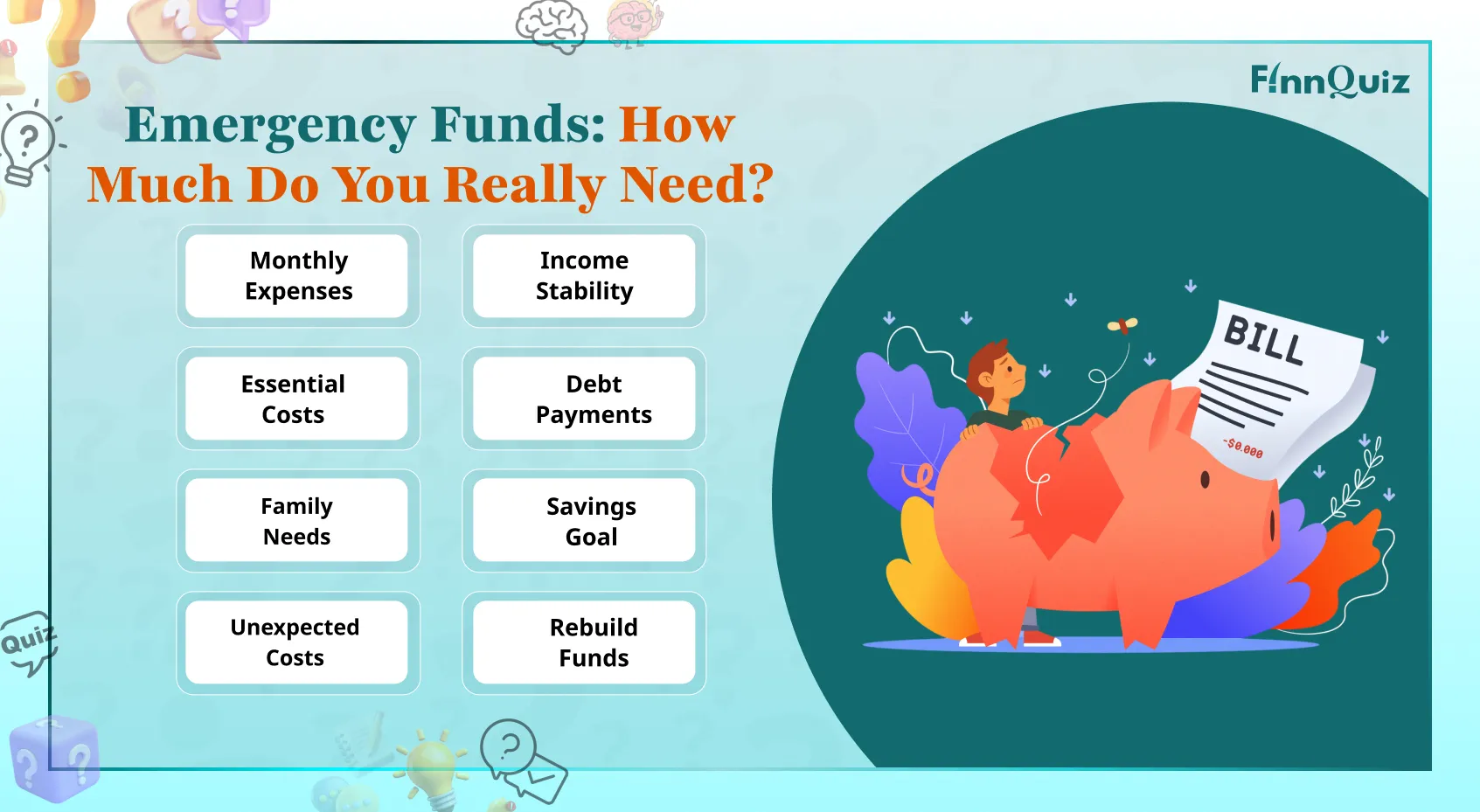
An emergency fund is a stash of cash set aside specifically for unexpected, necessary expenses: a car repair, a medical bill, a broken appliance, or—most importantly—a job loss. The standard advice says to save three to six months of living expenses. But that's a range, not a rule. The exact amount depends on your personal circumstances: how stable your income is, whether you have dependents, what your fixed costs are, and how quickly you could find a new job. This guide helps you calculate the right number for you and shows you exactly how to build it, step by step. You'll also get practical strategies to speed up your savings by cutting monthly expenses and adopting small habits that compound over time.
What an Emergency Fund Is (and Isn't)
An emergency fund is not a vacation fund, not a 'new phone' fund, and not a 'big sale' fund. It's your financial airbag—there for true emergencies only. A true emergency is unexpected (you couldn't plan for it), necessary (you need it to live, work, or stay healthy), and urgent (it can't be put off). Car repairs needed to get to work count. A new laptop because yours broke when you work from home—possibly. A weekend getaway—no. Keeping this definition clear helps you protect your fund from 'wants' masquerading as 'needs.'
How to Calculate Your Target Amount
The three-to-six-month rule is a good starting point, but you need to tailor it to your situation. Here is a practical method to zero in on your ideal number.
- Step 1: Calculate your essential monthly expenses. This is your baseline—the minimum you need to survive: rent/mortgage, utilities, groceries, basic transportation, insurance, and minimum debt payments. Exclude dining out, subscriptions, entertainment, and non-essential shopping. Let's say your baseline is $2,500.
- Step 2: Assess the risks the fund must cover. Consider income stability, dependents, insurance deductibles, essential repairs, access to paid leave, and how quickly income could be replaced. A number of months is a planning range, not a universal prescription.
- Step 3: Consider your support network. Do you have family who could help in an emergency? Do you have a partner with a stable income? If yes, you may need less. If you are the sole breadwinner with no backup, you need more.
- Step 4: Choose a first milestone tied to a real risk. It might equal an insurance deductible, a typical urgent repair, or several weeks of essential bills. A round figure such as $1,000 can illustrate the method, but it will not cover the same risks for every household.
| Scenario | Income Type | Recommended Fund Size | Example Target ($3,000 Baseline) |
|---|---|---|---|
| Single, stable job | Regular salary | 3–4 months | $9,000–$12,000 |
| Freelancer/gig worker | Irregular or seasonal | 6–9 months | $18,000–$27,000 |
| Sole breadwinner, family | Regular but volatile industry | 6 months | $18,000 |
| Partner has stable income | Regular or variable | 3 months | $9,000 |
Where to Keep Your Emergency Fund
The ideal location is a high-yield savings account that is: (1) easily accessible (you can withdraw the money in a few days without penalty), (2) separate from your checking account (to avoid temptation), (3) FDIC-insured (so your money is safe), and (4) earning a competitive interest rate. Online banks often offer the best rates. Avoid putting your emergency fund in the stock market or in a certificate of deposit (CD) with early withdrawal penalties—you need liquidity and safety, not growth.
How to Build Your Emergency Fund Faster
Building a three-to-six-month fund can feel overwhelming, but these strategies make it faster and easier.
- Automate your savings: Set up an automatic transfer from checking to your emergency fund on payday. Even $50 per paycheck adds up to $1,300 per year.
- Redirect windfalls: Any extra money—tax refunds, bonuses, gifts, side-hustle earnings—goes straight to your fund until it's fully built.
- Cut one category at a time: Instead of slashing everything, pick one area—e.g., dining out—and reduce it by 50%. Use the savings to boost your fund.
- Use a savings challenge: Try the 52-week challenge (saving $1 in week 1, $2 in week 2, etc.) or a no-spend week to accelerate progress.
- Replenish immediately: If you use your fund, make replenishing it your top priority in the following months.
Smart Ways to Cut Monthly Expenses and Free Up Savings
Reducing your regular monthly expenses not only helps you build your emergency fund faster but also lowers the target amount you need to save. Here are high-impact areas to focus on.
- Housing: Refinance your mortgage if rates have dropped. Negotiate rent at renewal. Get a roommate or rent out a spare room.
- Food: Plan your meals weekly and shop with a list. Reduce dining out by one or two meals per week. Buy store brands instead of premium labels. Use cashback apps.
- Transportation: Shop for auto insurance annually. Combine errands into fewer trips. Maintain your vehicle to avoid costly repairs.
- Subscriptions: Audit every recurring subscription and cancel anything you don't use at least weekly. Share streaming services with family.
- Utilities: Use energy-efficient bulbs. Unplug electronics when not in use. Adjust your thermostat by a few degrees—each degree can save 1–3% on heating and cooling.
Worked Example: Building a Reserve in Stages
In this hypothetical example, a worker receives $3,800 per month and identifies $2,100 of essential expenses: rent $1,100, utilities $200, groceries $400, transportation $150, insurance $50, and minimum debt payments $200. A $6,300 target represents three months for calculation purposes, not a recommendation based only on job stability.
She opens a high-yield savings account and automates a $250 transfer from each paycheck (she's paid monthly). She also reduces her dining out budget by $100 and cancels two subscriptions ($25), adding $125 extra per month. Total monthly savings: $375. She reaches her $1,000 starter fund in under three months and her full $6,300 target in about 17 months.
Six months later, her car needs a $1,800 repair. She uses her emergency fund to pay for it, avoiding credit card debt. She then increases her monthly savings to $500 until the fund is replenished. Her financial resilience is now a habit, not a hope.
Common Mistakes to Avoid
- Using the fund for non-emergencies: A new phone or a vacation is not an emergency. Be strict.
- Keeping the fund too hard to access: CDs or investments with penalties defeat the purpose.
- Not saving because the full target feels too large: Choose a smaller first milestone based on one likely urgent expense, then revise it as risks and income change.
- Failing to replenish after use: If you withdraw, refill it as a priority.
- Keeping it in a regular checking account: It's too easy to spend. Use a separate savings account.
- Not adjusting the target over time: As your expenses change, so should your fund target.
Small Saving Habits That Compound into Big Results
Beyond the big cuts, small daily habits can add a surprising amount over time. Here are habits worth adopting.
- Track your daily spending: Spend 2–3 minutes each day recording what you bought. Awareness alone often reduces spending.
- Use the 24-hour rule: Wait a full day before buying anything non-essential over $30. Most impulse urges fade.
- Carry water and snacks: Avoid paying $3 for coffee or $5 for a snack by bringing your own.
- Round up your purchases: Use a savings app that rounds up transactions to the nearest dollar and saves the difference.
- Set a weekly fun limit: Give yourself a fixed cash amount for entertainment, dining, and shopping each week. When it's gone, stop.
Exceptions and When the Rule Doesn't Apply
While three to six months is a good general target, there are situations where you may need more or less.
- If you have a partner with a stable income and no dependents, three months may be plenty.
- If you work in a volatile industry (e.g., tech, real estate, media), six months or more is prudent.
- If you have high-interest debt, compare the risk of holding no cash with the interest cost of the debt. A starter reserve may reduce reliance on new borrowing, but its amount should reflect likely urgent costs rather than a universal $1,000 rule.
- If you are retired or have substantial liquid investments, you may need a smaller cash buffer because you can draw from investments if needed.
Practical Checklist
- Have you calculated your monthly essential expenses (baseline)?
- Have you set a target amount that matches your income stability and family situation?
- Do you have a separate, accessible, high-yield savings account for your fund?
- Have you automated monthly transfers to your fund?
- Have you identified at least one expense category to reduce this month?
- Have you decided what counts as a 'real emergency' so you won't dip in for wants?
- Do you have a plan to replenish the fund if you use it?
Set Your First Reserve Milestone
This week, calculate essential expenses and identify the first specific risk your reserve should cover. Select an insured, accessible account after comparing current terms. Choose an automatic contribution that leaves enough for bills, then review the target after income, insurance, housing, or family circumstances change.