
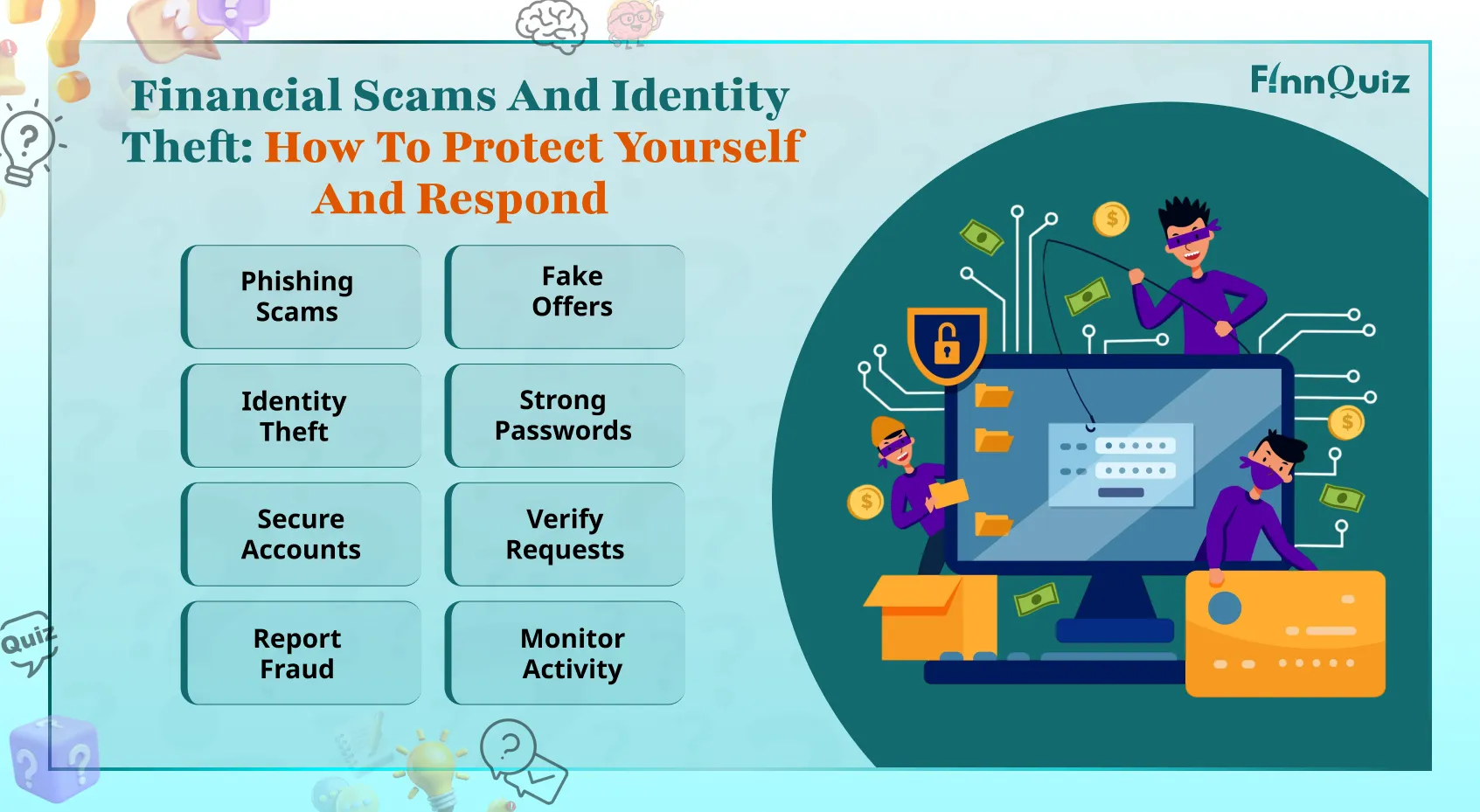
Financial scams and identity theft are real threats, but you can protect yourself by knowing the red flags and acting quickly if something goes wrong. The most common scams include phishing emails, fake bank alerts, investment promises, job offers, and romance schemes. To stay safe: use strong, unique passwords, turn on two-factor authentication, freeze your credit, and never share personal information in response to an unexpected request. If you think you have been scammed, act immediately—contact your bank, change passwords, report to the FTC, and place a fraud alert or credit freeze. This guide walks you through prevention, recognition, and a clear response plan.
Know the Difference Between Fraud, Scams and Identity Theft
- Phishing: Fraudulent emails, texts, or websites that impersonate a legitimate company to steal your personal information.
- Smishing: Phishing via text message (SMS).
- Vishing: Phishing via phone call.
- Identity theft: When someone uses your personal information (name, Social Security number, bank account) without permission to commit fraud.
- Two-factor authentication (2FA): A security feature that requires a second verification step (like a code sent to your phone) in addition to your password.
- Credit freeze: A free tool that restricts access to your credit report, making it harder for identity thieves to open new accounts in your name.
- Fraud alert: A notice on your credit report that requires lenders to verify your identity before opening new accounts.
- Social engineering: Manipulating people into revealing confidential information through deception.
The Most Common Financial Scams and Their Red Flags
Scammers use many tactics, but they often share common patterns. Recognizing these patterns is your best defense. Here are the most frequent scams targeting consumers today.
Phishing and Impersonation Scams
You receive an email, text, or call that appears to be from your bank, a government agency, or a well-known company. The message claims there is a problem with your account, a suspicious transaction, or a security alert. It urges you to click a link, call a number, or verify your identity immediately. The link leads to a fake website that captures your login credentials, or the phone number connects to a scammer who asks for your password, PIN, or one-time verification code.
Red flags: Unsolicited contact, urgent language, requests for personal information, links that look slightly off (e.g., "bankofamerica-secure.com"), poor grammar, and pressure to act now. Legitimate organizations will never ask for your password, PIN, or Social Security number via email, text, or phone.
Investment and Cryptocurrency Scams
Scammers promise high returns with little or no risk, often using social media, WhatsApp groups, or online ads. They may show fake testimonials, fabricated profits, or impersonate legitimate investment platforms. Common variations include "crypto arbitrage," "forex trading," and "guaranteed returns" schemes. They pressure you to invest quickly and may ask for payment via cryptocurrency, wire transfer, or gift cards.
Red flags: Guaranteed returns, pressure to invest immediately, lack of clear information about the investment, requests for unusual payment methods, and unverifiable testimonials. Legitimate investments always carry risk and provide detailed, verifiable documentation.
Fake Job and Payment Scams
Scammers post fake job listings or reach out with unsolicited job offers. They may ask you to pay for training, background checks, or equipment upfront. In a common variation, they send a fake check (often for too much) and ask you to deposit it and wire the excess back to them. The check eventually bounces, leaving you responsible for the full amount.
Red flags: Job offers that seem too good to be true, requests for upfront payment, pressure to accept quickly, and vague job descriptions. Legitimate employers will not ask you to pay for training or send money back.
Romance and Emergency Scams
On dating apps or social media, scammers build emotional relationships over weeks or months, then request money for emergencies—medical bills, travel, or legal trouble. They may also impersonate a friend or family member in distress, asking for gift cards or wire transfers.
Red flags: A person you have never met in person asks for money, refuses to video chat, has a story that constantly changes, or asks for payment via gift cards, cryptocurrency, or wire transfer. Be extremely cautious with online relationships that quickly progress to financial requests.
Comparison Table: Scam Warning Signs
| Scam Type | Common Red Flags | Example |
|---|---|---|
| Phishing (Email/Text) | Urgent request, suspicious link, poor grammar, asks for personal info | Text: 'Your account is locked. Verify here: [fake link]' |
| Investment Scheme | Guaranteed high returns, pressure to act fast, unusual payment methods | Social media ad: 'Double your crypto in 24 hours!' |
| Fake Job | Upfront payment required, unsolicited offer, vague role description | Job offer: 'Pay $200 for training materials, we'll reimburse you' |
| Romance | Asks for money, avoids in-person meeting, story changes | Online partner: 'I need $500 for a plane ticket to visit you' |
| Bank Impersonation | Caller requests password or 2FA code, creates urgency | Call: 'I'm from your bank fraud department. Please give me the code sent to your phone' |
| Fake Check | Check for more than the agreed amount, asks you to wire back the difference | Buyer sends $2,000 for a $500 item and asks you to refund $1,500 via wire |
Identity Theft Warning Signs
Identity theft may not show up as a single obvious event. Watch for these indicators:
- Unexplained transactions on your bank or credit card statements.
- Unfamiliar accounts or inquiries on your credit report.
- Calls or letters from debt collectors about debts you do not owe.
- Missing mail, such as bank statements or credit card offers.
- Unexpected denial of credit or higher interest rates than expected.
- A notice from the IRS about unreported income or a tax return filed in your name.
Proactive Protection: What to Do Before an Incident
The best defense is a strong offense. Implement these practices to reduce your risk.
- Use strong, unique passwords for every account. A password manager can generate and store them securely.
- Turn on two-factor authentication (2FA) for all financial accounts, email, and social media. Use an authenticator app instead of SMS when possible.
- Freeze your credit at all three major bureaus (Equifax, Experian, TransUnion). It is free and prevents new accounts from being opened in your name.
- Place a fraud alert if you are not ready to freeze, or as an extra layer. It requires lenders to verify your identity before opening new accounts.
- Monitor your accounts at least weekly. Set up alerts for transactions over a certain amount.
- Check your credit reports annually for free at AnnualCreditReport.com. Stagger them (e.g., one every four months) for year-round monitoring.
- Shred documents with personal information before discarding.
- Be careful on public Wi-Fi—use a VPN or avoid banking on public networks.
- Keep your devices and apps updated to patch security vulnerabilities.
What to Do If You've Been Scammed: First 24 Hours
If you believe you have been scammed, time is critical. Follow these steps immediately.
- 1. Stop all communication with the scammer. Do not respond further.
- 2. If you shared financial information or made a payment, contact your bank or credit card issuer immediately. Ask them to freeze or close affected accounts and dispute unauthorized charges.
- 3. Change passwords for any accounts you may have exposed, starting with email and financial accounts. Use new, strong passwords.
- 4. If you suspect your identity has been stolen, place a fraud alert or credit freeze with one of the three credit bureaus (they will notify the others).
- 5. Report the scam to the Federal Trade Commission (FTC) at ReportFraud.ftc.gov or IdentityTheft.gov if your identity was used.
- 6. File a police report with your local law enforcement, especially if you have lost money. Bring any documentation you have.
Specific Scenarios: Compromised Information
If you have shared specific types of information, take these additional steps:
If You Shared Your Password
Change the password immediately. Also change it on any other accounts that used the same password. Enable 2FA if you have not already. If you use a password manager, change the master password.
If You Shared a Credit or Debit Card Number
Contact your bank or card issuer to cancel the card and request a replacement. Review recent transactions and report any unauthorized charges. Under federal law, your liability for unauthorized credit card charges is limited to $50 (often $0 with major issuers). For debit cards, liability can be higher depending on how quickly you report, so do it immediately.
If You Shared Bank Account Details
Contact your bank to place a hold or close the account if necessary. Open a new account and transfer all automatic payments. Monitor the account closely for unauthorized withdrawals. Ask your bank about fraud protection services.
If You Shared Personal Identity Information (SSN, DOB, etc.)
Place a fraud alert or credit freeze with the credit bureaus. Report identity theft to the FTC at IdentityTheft.gov to get a recovery plan. Review your credit reports for new accounts and dispute any that are fraudulent. Consider adding an extended fraud alert (7 years) if you have a police report.
How and Where to Report Fraud
- Federal Trade Commission (FTC): Report most scams at ReportFraud.ftc.gov. For identity theft, use IdentityTheft.gov to create a recovery plan.
- FBI Internet Crime Complaint Center (IC3): File a report for internet-related crimes at ic3.gov.
- Your local police department: File a report for any fraud that involves a financial loss. Bring documentation.
- Your bank or credit card issuer: Report unauthorized transactions immediately. They can freeze accounts and investigate.
- Credit bureaus: Contact Equifax, Experian, or TransUnion to place a fraud alert or credit freeze.
Common Mistakes and Consequences
- Ignoring small, suspicious charges: A tiny transaction could be a test; report it immediately.
- Reusing passwords: A breach on one account puts all others at risk. Always use unique passwords.
- Not using 2FA: Passwords alone are not enough; 2FA adds a critical layer.
- Delaying response: The faster you act, the less damage you incur. Do not wait.
- Clicking links in unsolicited messages: Even if they look legitimate, verify by going directly to the official website.
- Falling for pressure tactics: Scammers create urgency to bypass your critical thinking. Slow down and verify.
Exceptions and Limitations
No single security measure is foolproof. Credit freezes and fraud alerts are free and recommended, but they do not prevent all types of fraud—they primarily stop new account openings. They also do not protect against unauthorized charges on existing accounts, which is why account monitoring is essential. Also, free credit reports from AnnualCreditReport.com do not include scores; they are for reviewing information. If you need scores, many banks and credit monitoring services offer them for free.
Prevention Checklist
- I have placed a credit freeze or fraud alert with all three bureaus.
- I use strong, unique passwords for every account (consider a password manager).
- I have enabled 2FA on all financial and email accounts.
- I review my bank and credit card statements weekly.
- I check my credit reports at least once a year.
- I shred documents with personal information.
- I never share passwords, PINs, or 2FA codes with anyone.
- I verify unsolicited requests by contacting the organization through official channels.
- I report suspicious activity to my bank and the FTC immediately.
Set Up Your Fraud-Response Kit
This week: place a credit freeze with all three bureaus (it is free and takes about 15 minutes each). Set up 2FA on your banking and email accounts. Create a schedule to check your accounts weekly. Download the FTC's identity theft recovery guide from IdentityTheft.gov. If you ever receive a suspicious message, pause, do not click, and verify directly. Stay informed by following official consumer protection sources.